
The summer before Covid hit I had the chance to re-visit the Catholic Cathedral in Liverpool, England–one of the most beautiful buildings I’ve ever seen. I’d been wanting to go back ever since I first saw it in 1975 when I went with a friend who was studying architecture at the University of Liverpool. We had a heated discussion about whether the Cathedral, then almost new, should ever have been built. He argued that the money should have been spent on public housing. I said there was value in a sanctuary that anyone could go to for rest and spiritual sustenance. As I walked around it again so many years later, through shafts of sapphire, crimson, green and gold as the sun pierced the stained glass, listening to the soft voice of the elderly Irish-accented guide explaining what it meant to his community, how everyone contributed what they could to build it, the symbolism of this place of solace on the site of the Victorian workhouse where so many Irish immigrants to Liverpool lived and died, I still thought I was right.
That was a year and a half ago. Last summer at the same time we were all staying home and finding solace in our own communities. I started out doing a lot of hiking along our spectacular coastline but then I got plantar fasciitis and it was too painful to walk very far. However, I could still cycle as the injury was on my heel, and so my bike became my mobility device and the Waterford River Trail my sanctuary. I rode there almost every day: along the waterfront and into the woods where I could feel free and happy away from cars and the noise of the city. The river and the trees opened up vistas of delight: I stopped here and there to picnic or watch small birds and animals, as the wild raspberries and apples gradually ripened, the river flowed through woods and meadows to the harbour, and the leaves changed with the seasons from pale to brilliant green and then to the golds and reds of fall.
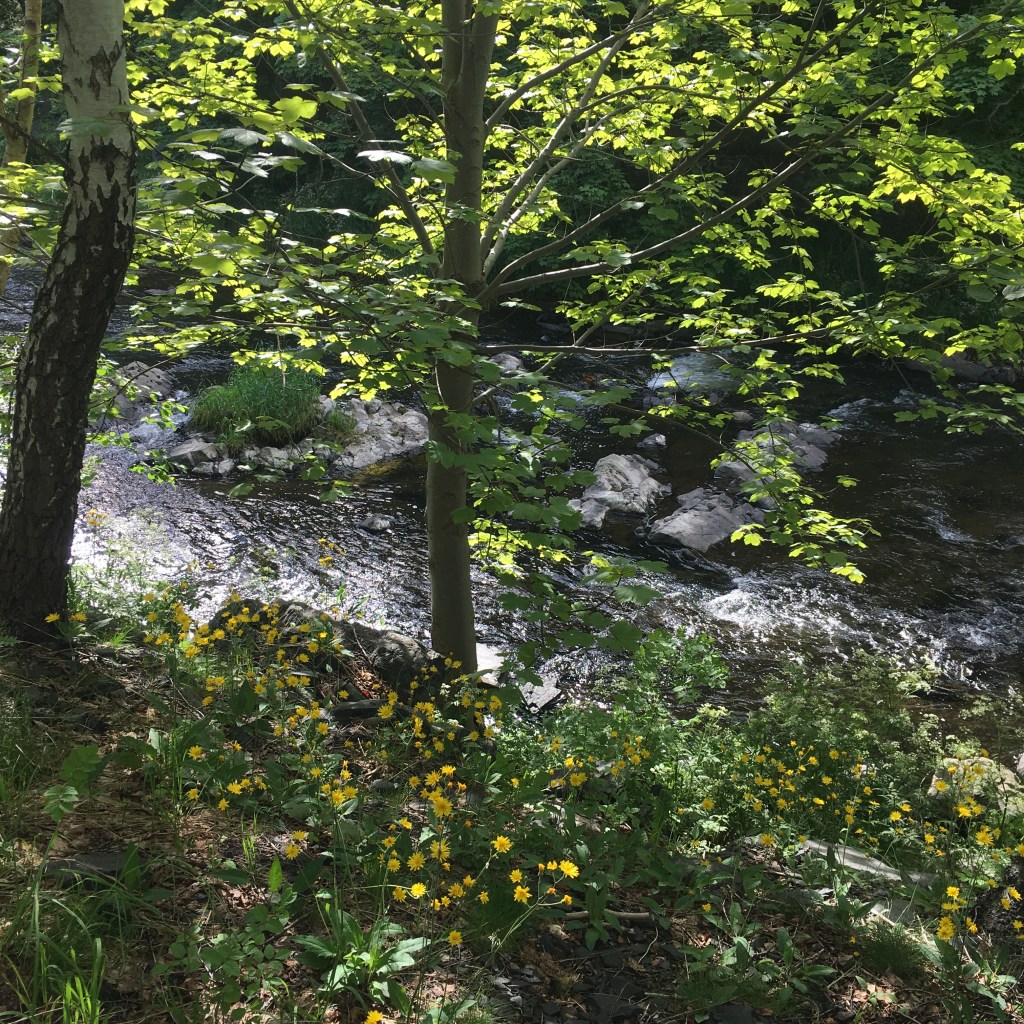
What does the idea of sanctuary have to do with the St. John’s Bike Plan? Last week I attended a focus group on the Kelly’s Brook Trail, the first project in the bike plan. I can’t quote people directly because of confidentiality but the group included participants with many different perspectives, some for the trail and some against (though apparently more strongly opposed to the proposed future projects involving the Rennie’s and Virginia River trails). One person, who seemed averse to the bike plan, said that the fundamental problem was car culture: the fact that the city makes no provisions for safe cycling and very few for getting around, especially in winter, by any means other than a private vehicle. Another spoke of how the Rennie’s River trail is a sanctuary that should not become a commuting corridor.
I support the Bike Plan because we have nothing else, because we desperately need ways to get around outside the car–both for commuting and for sanctuary. I don’t think those things are necessarily separate. For example, someone mentioned in a social media thread recently how aggravating it is that the paths through Bannerman Park are cleared of snow in winter yet the sidewalks aren’t. Someone else responded that children walk through the park to school as a safe off-street route. I would add that it also gives them a peaceful and beautiful aesthetic experience every day as they travel back and forth, and they need that as well as basic safety. Active transportation is kind of a utilitarian term but part of its value is that commuting can be good for the soul as well as the body.
We need routes and trails that are accessible to all: where someone with a guide dog can safely walk without the dog being traumatized because there is no safe route to lead them on; where a person using a wheelchair or a modified bicycle can enjoy the kind of sanctuary I found last summer along the Waterford River; where children can travel safely to school.
How do we balance these things? We need much more than a bike plan. We need an overarching vision and concrete objectives for all forms of transportation. We need to prioritize active transportation because it’s good for the climate as well as for our health and happiness. We will all need to make compromises: to find ways to make the river trails accessible to mobility devices; to consider whether parts of these trails might be developed into commuter zones while other sections are not; to accept that some cycling routes will be along protected street corridors, which won’t be so peaceful but will leave some spaces for slower enjoyment. We need a whole network of active transportation commuter routes and recreational trails, and we need to think about how they will all fit together, how to ensure they are accessible, and how to maintain them year round. We need this because mobility is a human right; because we have to protect our planet; and because now, more than ever, we need sanctuary.
 Road Rage
It’s difficult to come to agreements on plans. There was an online survey here in Winnipeg, about these types of plans. One comment I noticed was from a man who felt bike paths were a waste of money because no one uses them. I have a few points about that: Yes, they do if they are safe and well-located. Just because they aren’t busy when you are nearby doesn’t mean they aren’t busy at other times. (I know I use them and I do see areas where the paths are very busy at rush hour downtown, but not on weekends or busy on weekends near parks, but not at rush hour. And, until there are enough paths to make it safe and convenient for many bike riders, some paths are not busy, but the more paths the better it gets and more people use them. Then there will be fewer bikes on the streets and car drivers will like that & less car traffic on the streets reducing rush hour congestion. I hope I made sense here. Typing fast. 😊 🚴♀️
LikeLike
So true, Louella. We need whole networks of safe and enjoyable ways to get around without cars. I think Winnipeg is moving in that direction faster than we are. Amazing stories of year round cyclists there!
LikeLike