The St. John’s candidate debates this year were wonderfully refreshing in that almost all the candidates emphasized accessibility, better public transit and clear sidewalks year round. Most also talked about cycling infrastructure. What they will actually do if elected is a different question but the way they spoke suggests a real cultural change in attitudes on transportation and a move away from car culture.
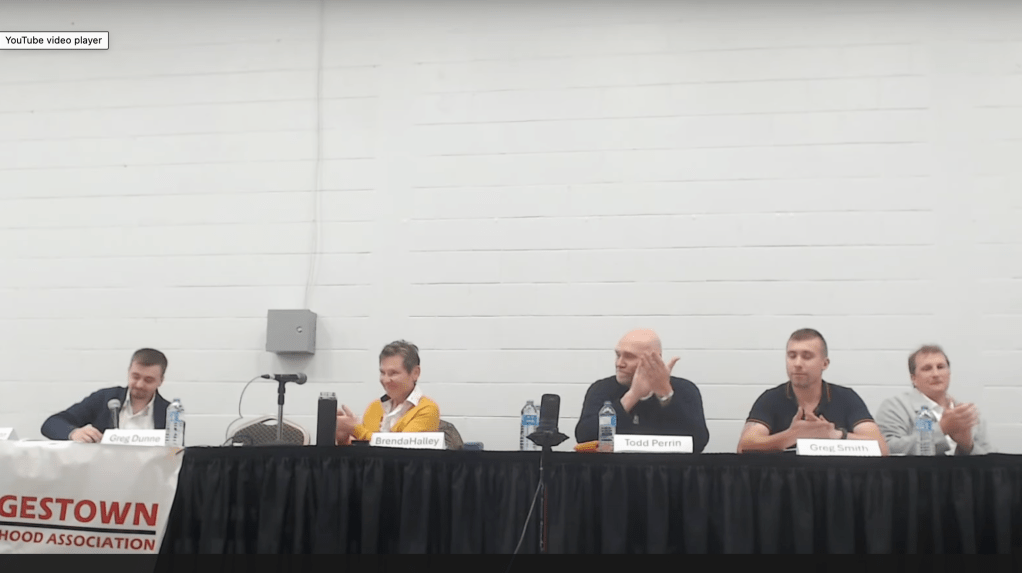
Ward 2 was the only ward to have its own debate, probably because it’s the only one with more than two candidates. All of the Ward 2 candidates seem to be knowledgeable and committed on these issues. Here’s what they said about getting around the city:
The question: A modern inclusive city must ensure safe and accessible transportation for all, whether on foot, bike, bus or car. What are your top priorities for improving mobility in Ward 2 and how would you invest in infrastructure and policy to support active transportation, public transportation and accessibility for people of all abilities?
Philip Barton: The biggest problem with public transportation is that you cannot plan ahead. When you’re taking the bus, we need screens that are going to tell us when you’re going to arrive, when there’s a delay, so people don’t have to call or look something up, they can just look and see it, like they do in subways, like New York City, so you can know you’re not going to get to work on time, plan ahead, get a taxi. Another thing about transportation in this city: we have an Uber problem. Let’s be honest. It pays a slave wage, it’s driving our taxi companies out of business. Big tech companies, they go bankrupt all the time. Uber goes bankrupt, all the cab companies are gone, and we’ve got no cab system in our city. So we need to protect these cab companies that have been around for a while, to make sure they’ll be around. If we’re going to be elbows up, yay Canada, we can’t be supporting an American company that’s basically forcing people to work for pennies. I also think that we need to have separate bus lanes so we can get places faster, more bus stops so people won’t have to walk thousands of kilometres to get to a stop, and the biggest thing is we do need more buses, more people are using it, and of course, going back to the thing about businesses, people are having to go a thousand miles, they have to go to Mount Pearl to find stuff, to get a mortgage, if we could create more jobs in the city, people would have to use the transportation less. The solution shouldn’t be to have people in gas guzzling [vehicles] creating greenhouse emissions.
Greg Dunne: Absent
Brenda Halley: Our transportation system as we know it is not accessible, it doesn’t work, it’s very old and it needs to be revamped. I was just shopping at Dominion the other day and a young cashier asked me if I could help her. I asked why and she said that she lived in Shea Heights, the bus system doesn’t go to Shea Heights on Sundays at all, and doesn’t go past six o’clock in Shea Heights. The busses are not accessible. A friend and I were discussing that there was a mother with a child in a wheelchair and the bus driver had to turn them away, they couldn’t get the child onto the bus with a wheel chair. We’ve lost our bus shelters. Many of them are gone. One of the reasons we were told that they were taken down by City Hall was that there was excessive drug use and people were being sexually assaulted in them. So there we go with the police control, and the horses again [in an earlier question she had talked about the value of police on horseback]. I think that we can do better. We have bike lanes. The city are doing well with bike lanes, but I think we can do better. We need more. Every time my partner goes… you can see my biking short here. We’re a family of five and we bike. If one of us drive, one of us bikes. My kids use the bus all the time. They love it. It gets them all around the city because I can’t take them all around the city. The bike lanes are great but they’re not everywhere and in this city the drivers go really go fast. You’re taking your life in your hands. So when my partner bikes to work every morning for the last eighteen years, I always say, can you call when you get there? Because I always wonder if she’ll arrive alive.
Todd Perrin: Clearly, accessibility and ease of getting around the city is of the highest importance. The Metrobus has come a ways in the last few years: they went from no one on the buses to too many people on them at times. We need to invest in their infrastructure, to Brenda’s point, which is a good one and I’ve heard a lot of the same things from folks who work with us. The buses run on a schedule that’s convenient for them, and not for when people need to be on a bus, so I think they need to take the customer into consideration in terms of who’s riding and where they’re going, when they need to be there. It is, after all, a service for the people of the city, not something the city should run the way they want to run it. It is something that needs to be considered. Also, on the whole transportation issue, the city has become way too focussed on cars. We talk about cars and parking, we talk about housing and development and all that kind of stuff but how many developments have been turned down in the city because they’ve got three parking spots too few. We’re so focussed on the number of cars that can be piled up in front of a building to the detriment of growth and better accessibility and places for people to live. So that whole piece of it is something that needs to be considered. But obviously you can’t start restricting cars and having development without parking or less parking if we don’t have alternatives and other ways for people to travel. We need more bike lanes and accessibility for bikes around the city. It’s not a great city for biking obviously. Its narrow road system is not built for that, there’s a lot of infrastructure changes that would have to be made. A big part of it too is a public campaign, let people be aware there’s bikes on the road. People drive around town and they’re very oblivious to bikers and walkers and everything else: too many cars on too small roads, too poor infrastructure, we need to rethink the whole way we do things about that.
Greg Smith: This issue hits home for me. I’m 29, 20 years of my life I’ve spent solely as a pedestrian and a user of public transit in the city, going to and from work and services and everything. To echo what Philip said, we need audio and visual announcements on the bus. It needs to happen. We need to make sure that we have accessible stops year round for people, how many times are you walking through snowbanks, just to get to a bus stop? That’s not good enough. We need to have more bus shelters in this city. Taking them away doesn’t address the issue of why they were taken away—they need to exist across the city. I work at the airport. I bartend and I serve. I use Route 14—very dumb route. It tries to encompass the airport route and it also tries to encompass residential. I’ve been late for work many many times. We need to have a route to the airport that is express, that goes from the downtown core to the Avalon Mall, to MUN Centre and straight on to the airport. We also need to have more routes in this city. We need more buses. We need some routes that address not just the issue of frequency—that is an issue and a huge one— but capacity is an issue. Three times in the rain and the snow I was if you can fit in until the next stop, get on. If not, what was I supposed to do? Wait half an hour? No, we need some accordion buses like Halifax had thirty years ago on certain routes that make sense geographically so we can address the issue of capacity. When it comes to transit on a greater scheme, outside of Ward 2, we need to work better with other members of the metropolitan area so we can invest more. We need better snow clearing for sidewalks and we need to invest more to make sure we have bike lanes so that you can wheel and walk safely year round because getting around your neighbourhood should be a human right.
Blair Trainor: You made some great points there, Greg. Raise your hands, how many people here ride the bus on a consistent basis? That’s good. [Lots of people raised hands.] I don’t know if I have anything to say to you. How many people know this song? “I got a limosine that’s fifty feet long, forty feet long… take the bus.” I think that we’re preserving the heritage of that song, and that needs to change. My wife takes the bus. We have one car. We’re modest living but two cars and two car payments you’re looking at 6-10 thousand dollars extra per year or $22.50 a month [for the bus] so she walks about fifteen minutes to get to her bus stop, she works at MUN and rain, snow or shine, she walks there because I take the car. I work in Paradise. I’d love, love, love to be able to take public transportation to Paradise. However, we need municipal partnerships. We don’t have them. St. John’s recently went to CBS to help out with the infrastructure there and you know that highway that was built there by Mount Pearl Square. It was never developed, the city helped build it. Right now the city of St. John’s has 850 thousand dollars invested into development with other municipalities. When we talk about transportation, I would love to be able to ride the bus and in order to do that we need collaboration with all those other municipalities, and we need people to trust our public transportation, and we need to create a new slogan!
You can watch the full debates here.
And see their platforms and contact information here.
 Road Rage