This morning I got up early to go for a cold but sunny walk with CBC reporter Darrell Roberts to check out walking conditions three days after the latest storm. You can hear about what we saw here.
Darrell also did an excellent multi-platform report last week on sidewalks and safe routes to school. Thank you so much, Darrell and CBC, for your unwavering support on this fundamental human rights issue!
Something I may not have said as clearly as I would have liked in these interviews is this: Why do spokespeople for the City of St. John’s say over and over that it’s too challenging to provide safe routes for pedestrians when they would never say that for drivers? On Monday, Lynnann Winsor, deputy manager of public works, said that all the streets had been plowed at least once but sidewalks would have to wait as “a lot of sidewalk snow-clearing equipment is too small for the current amount of snow.” Last week, Councillor Jamie Korab, Lead for Public Works, said “hopefully in future years more money will be invested” in sidewalks and then went on to talk in some detail about what they do “to make sure all roads are clear” even though he had been explicitly asked about sidewalks.
I understand that conditions are a factor but that excuse is not used for leaving streets uncleared. That just never happens. I guess my real question is why are pedestrians considered expendable when conditions get challenging?
Update on yesterday’s post: I received two responses. Councillor Maggie Burton said she will find answers to my questions but it may take a while. I’ll post them as I get them. Councillor Sandy Hickman said that staff were just getting going because the snow had only ended around 4:00 AM. It is true that more work is still being done on sidewalks but I sent the following response on that:
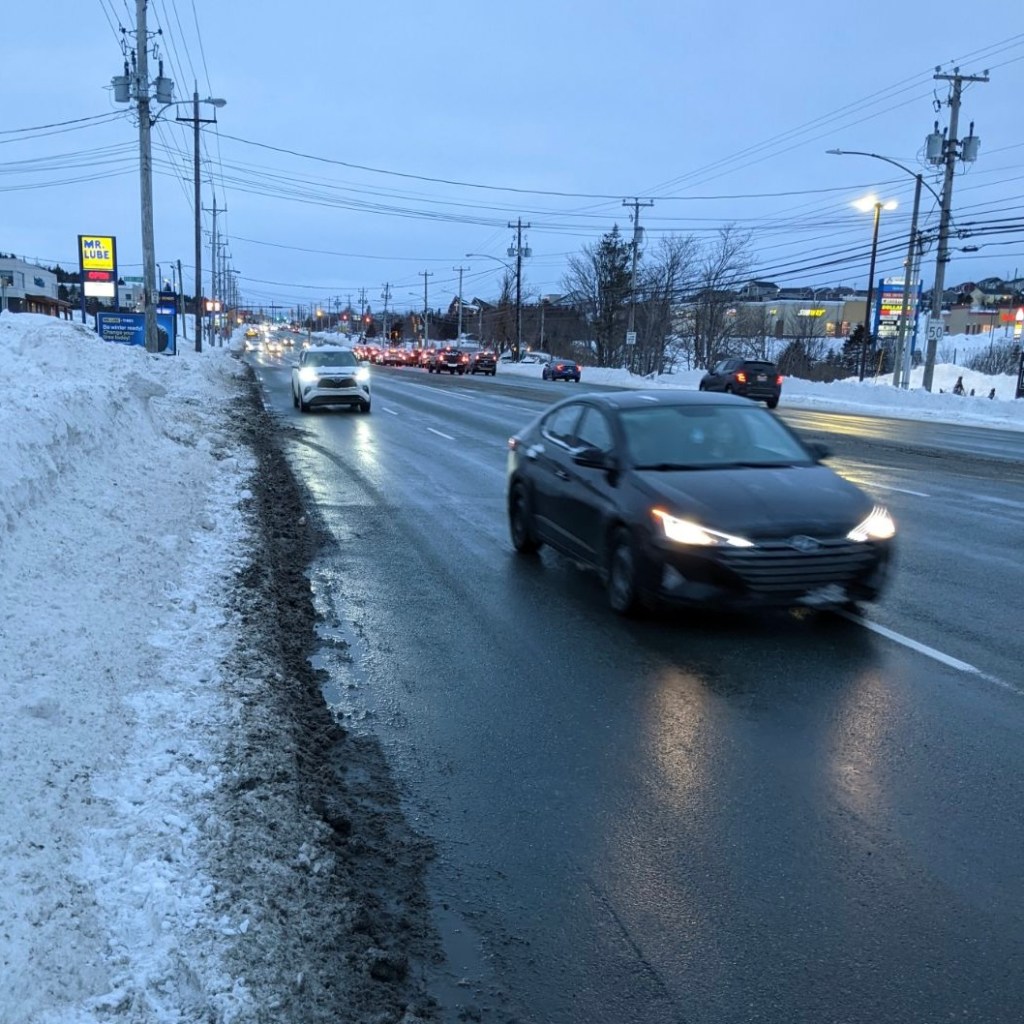
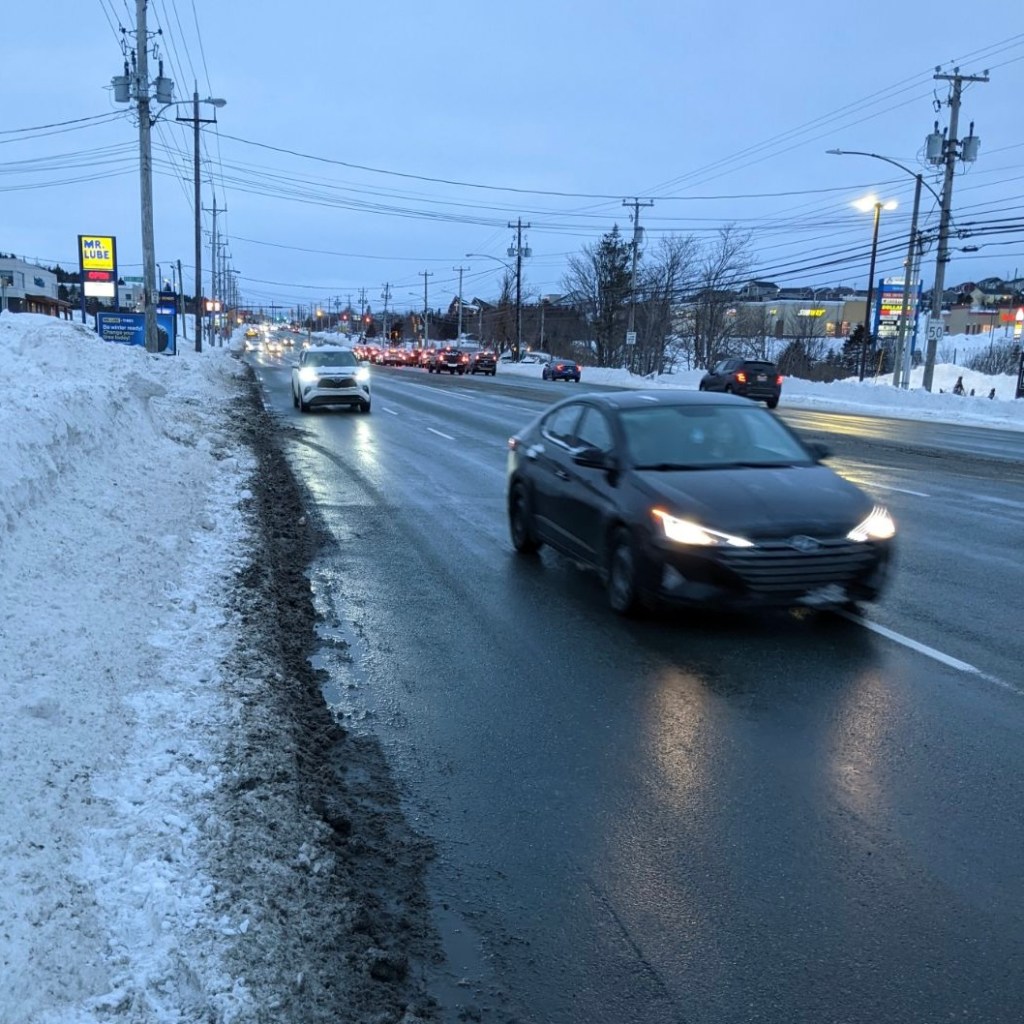
“I understand your point but the streets were down to bare pavement while there had not been even a preliminary pass on that stretch of sidewalk on Kenmount Rd. by 5:00 PM. Pedestrians and people waiting for the bus had to walk and stand in rush hour traffic as it got dark, the most dangerous time of day. We know that more and more people in the city are using the bus as their primary mode of transportation. The photo below shows the kind of conditions they often have to endure to do so.
The problem is not so much timing as severe under-funding. There is only so much staff can do with inadequate resources. In 2020 former councillor Ian Froude stated that Halifax, for example, spent about twice as much as St. John’s per kilometre on sidewalk clearing even though they receive less than half the snow load. What is our current amount budgeted for sidewalk clearing? This is a budget item that has a severe and indeed life-threatening impact on the lives of many residents of our city.”
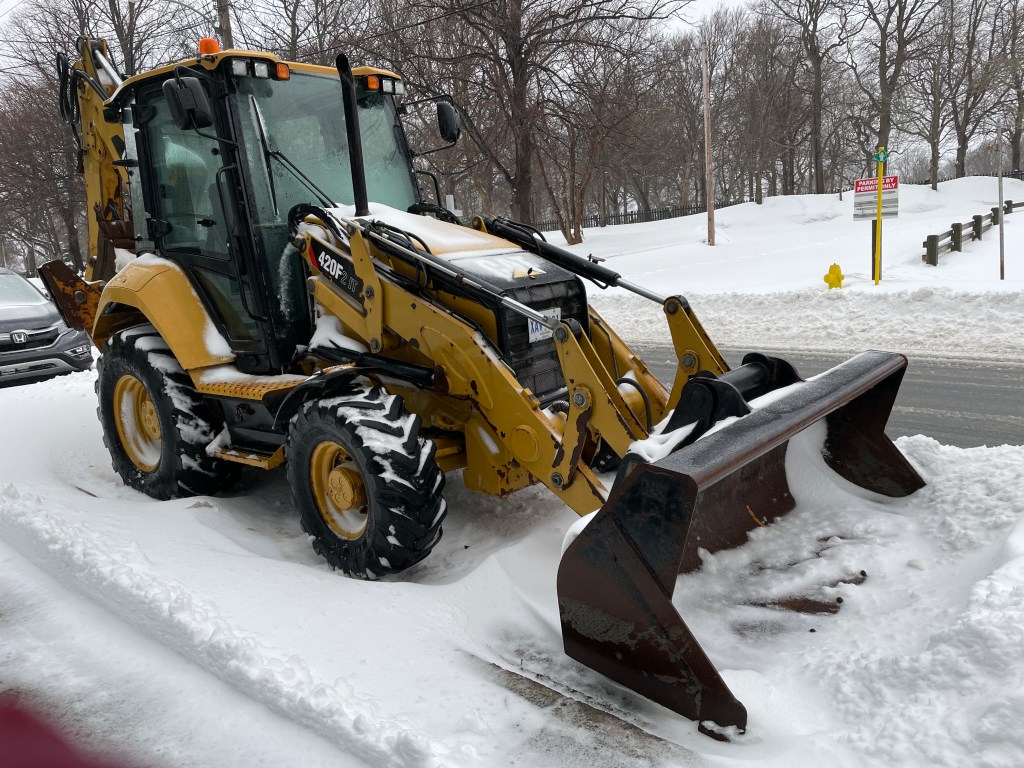
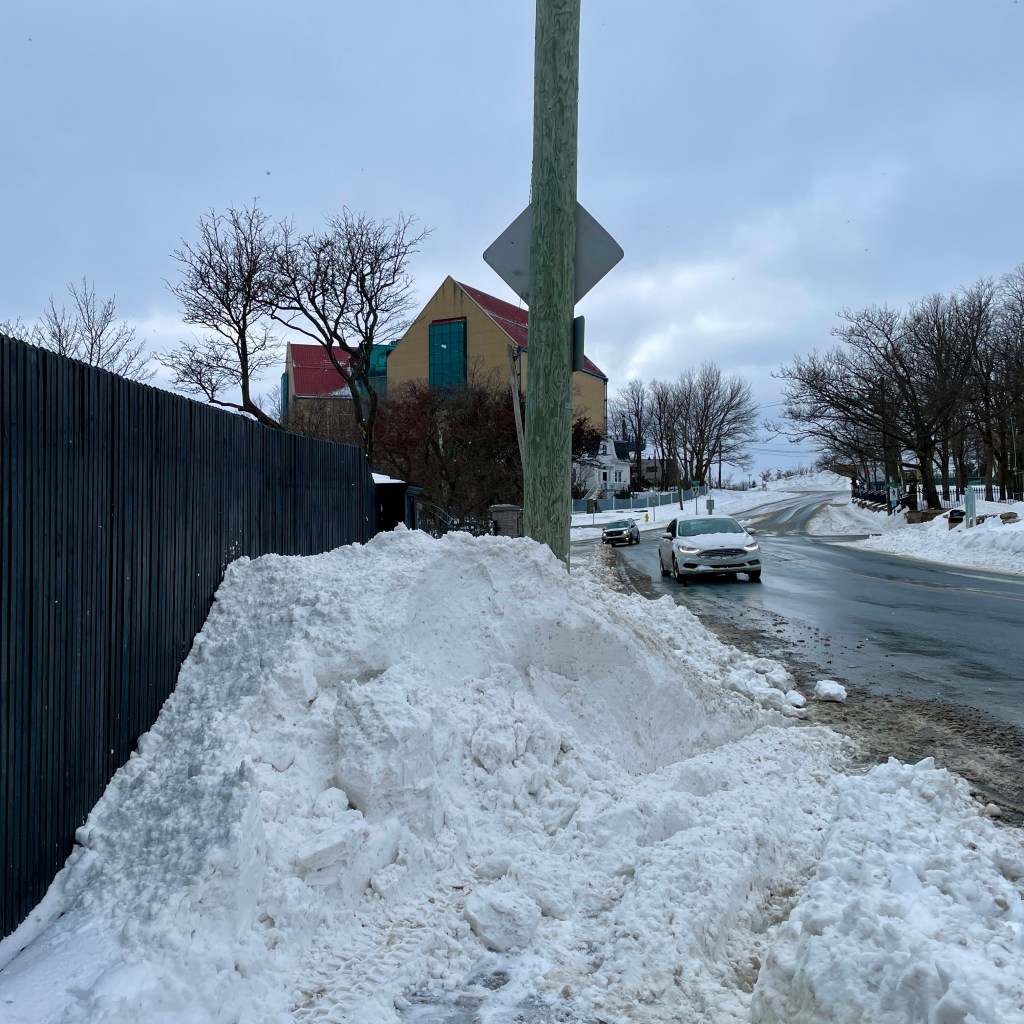
Photo of blocked sidewalk and crosswalk outside old BIS building on Queen’s Rd.
I sent this letter (slightly edited here and with photos and links added) to Councillors Maggie Burton and Sandy Hickman (Lead for Transportation) this morning in response to a letter from another concerned resident that I was copied on. I’ll post responses to my questions when I receive them:
Yesterday I walked along Queen’s Rd, Military Rd. and Bonaventure Ave. and later took the bus for an errand on Kenmount Rd. They were doing the sidewalk on Queen’s Rd as I went out, just after 1:00. The sidewalks on Military and Bonaventure had probably had one pass from the sidewalk plows but sections had been plowed back in again. Most of Kenmount had also had one pass from the sidewalk plow but the last part of our walk to the bus stop at 297 Kenmount had no sidewalk at all. It was getting dark and it was rush hour so walking in the street was nerve wracking to say the least. There was no space cleared at the bus stop either so we had to continue to stand in traffic until the bus came. All of these are Priority 1 sidewalks and three of them are bus routes.
View from the bus stop on Kenmount Rd. with high snowbank and oncoming traffic bearing down on pedestrians
These streets were cleared down to bare pavement during the night and were ready for people to drive to work and school in the morning. People who walk or take the bus (including many with disabilities and many seniors and children) had to commute in the traffic lanes or stay home.
I know there have been significant improvements in the past few years. The problem is that we started at such an abysmal place that the service is still utterly inadequate. After my experiences yesterday I have some questions about the City’s plans for continuing to improve this fundamental part of the urban transportation system:
The sidewalk beside the old BIS building on Queen’s Rd. had a mountain of snow on it because the owners cleared its entrance and left the snow blocking the sidewalk (see the photo at the top of this post). This is just one example among many. As you know, this is illegal but in the past the by-law has not been enforced as an ATIPP revealed. Does the city have any intention to enforce this by-law in future?
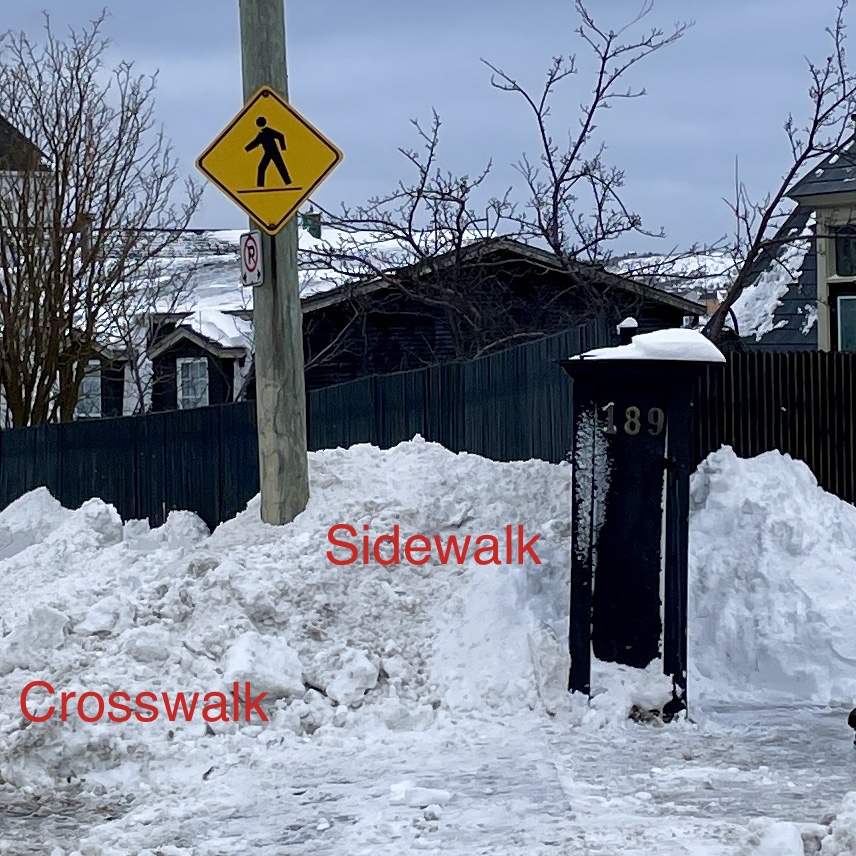
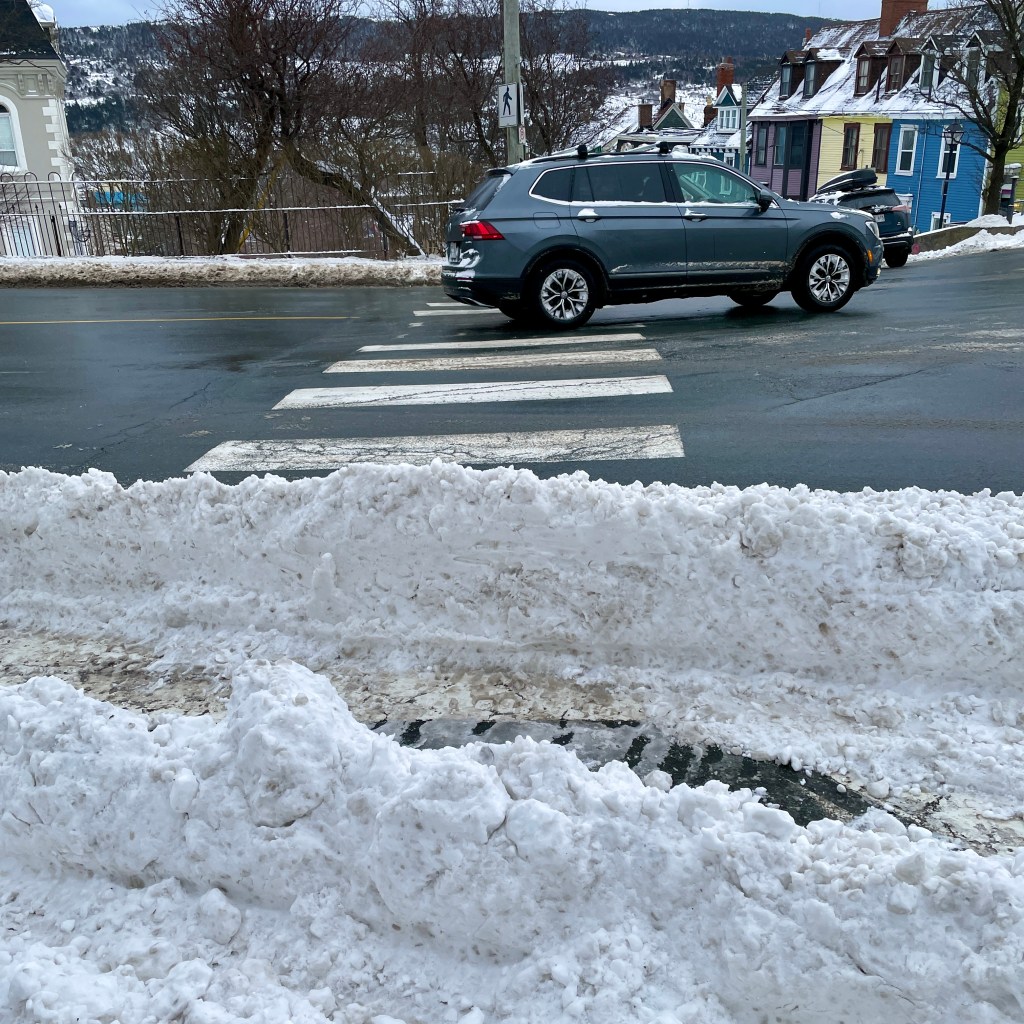
Most crosswalks still had piles of snow blocking access late yesterday afternoon (see photos below). Sandy, during the last election you stated that, in winter, crosswalks, intersections and bus stops “need to be clear with open spaces for access.” There has been some progress on this, which is to say where nothing was done before sometimes they are cleared now, but pedestrians need to be able to rely on safe routes all the time, just as drivers do. Does the City have a plan to make this happen?
The City’s website states in relation to sidewalk snowclearing, “our standards are like other cities with weather conditions comparable to ours.” This is not true. We are an outlier. What our own consultation found in 2014 was that we have higher standards for streets and lower standards for sidewalks compared to other cities. And our sidewalk standards are not just a little lower, they are exponentially lower. Of the five comparison cities in the consultation, four aim to clear all or nearly all their sidewalks within hours—not days—of a snowfall and the fifth has a goal of 62%. In 2021 former councillor Hope Jamieson stated that St. John’s was still clearing only 10% of its sidewalks. How much has been added since then and when will the timelines be shortened?
The province should also have a role to play in this. We are the capital city. Half the population of the province lives in or near St. John’s and the rest come here at times to visit or avail of services. The recent Health Accord showed that this province has the worst health in the country and it is well documented that there are significant correlations between walkability and health. Research done right here by Asia Holloway, Brianne Chafe and Daniel Fuller (which was presented to Council several years ago) showed that investing in walkability would bring four-fold economic returns over ten years. The problem is that the City has to do the investing but the Province would receive most of the returns since they are largely in health care savings. Has the City discussed this issue with the Province?
Thank you,
Elizabeth Yeoman
Sidewalk on Military Rd. at Bonaventure completely blocked by a pile of snow left by a city plow.Crosswalk on Queen’s Rd. blocked by piles of snow left by a city plowCrosswalk on Military Rd. near the Rooms, the Basilica and two schools, completely blocked by snow on both sides
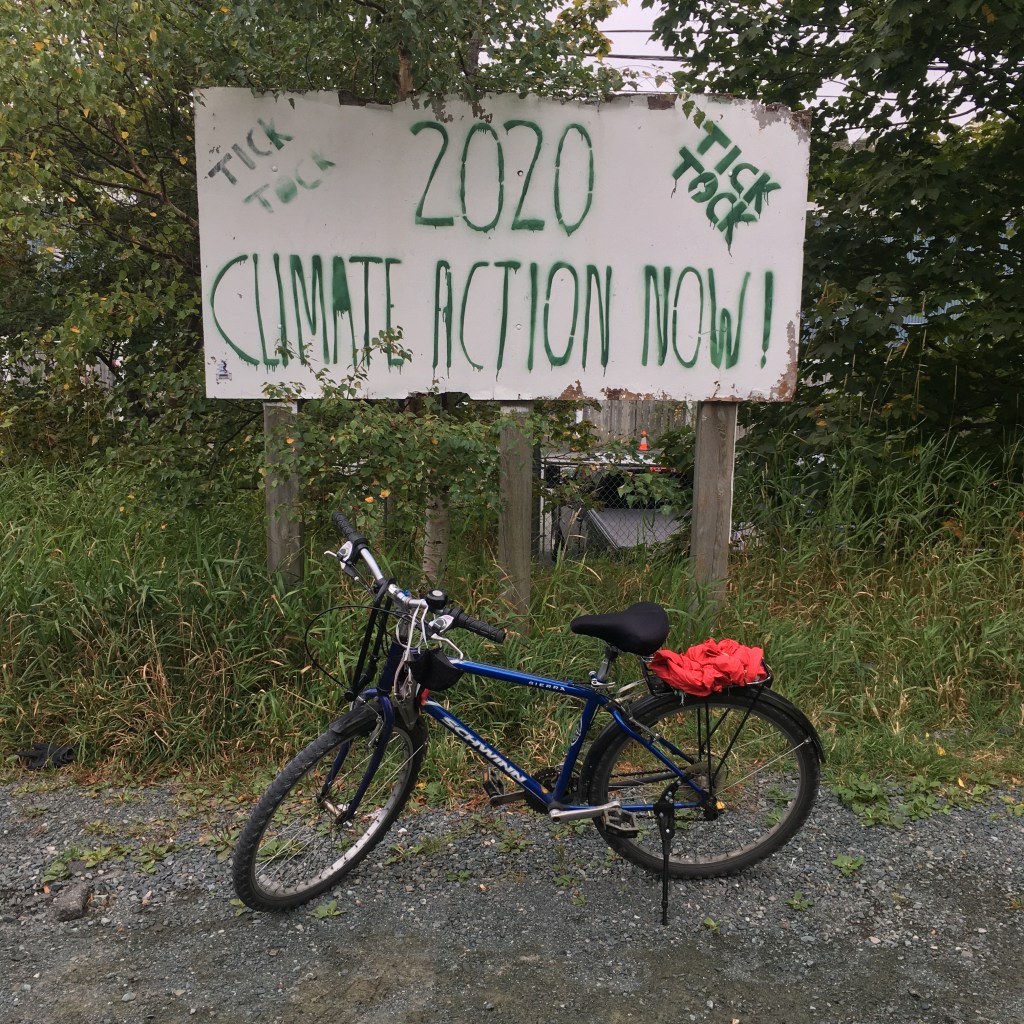
Bicycle on a gravel trail in front of a sign saying 2020 Climate Action Now Tick Tock Tick Tock.
I saw this sign three years ago on the Waterford River Trail, the only bit of cycling infrastructure we have anywhere near the city centre in St. John’s. At the time I was optimistic that more would soon be built. All levels of government said they would.
Emily Doyle wrote a letter to the Telegram last week explaining why she and her children decided to break the rules and ride on pedestrian trails. I do too, and on sidewalks. I don’t want to break the law or to inconvenience pedestrians but I want my grandchildren to know I did what I could to leave the world livable for them, and also to make our community one where they could move around freely and safely. Is it time for civil disobedience? I think it’s long past time.
Snowclearing policy and practice in other cities of Eastern Canada are nothing like St. John’s. Although the City’s website states, “our standards are like other cities with weather conditions comparable to ours,” this is not true. We are an outlier. What our own consultation found was that we have higher standards for streets and lower standards for sidewalks compared to other cities. And our sidewalk standards are not just a little lower, they are abysmally lower. While many other cities clear all or nearly all their sidewalks within hours of a snowfall, St. John’s only clears about 10% and it only does them within seven days, and maybe not even then if more snow falls in the meantime. Here are the details of what they do in some other cities:
Halifax
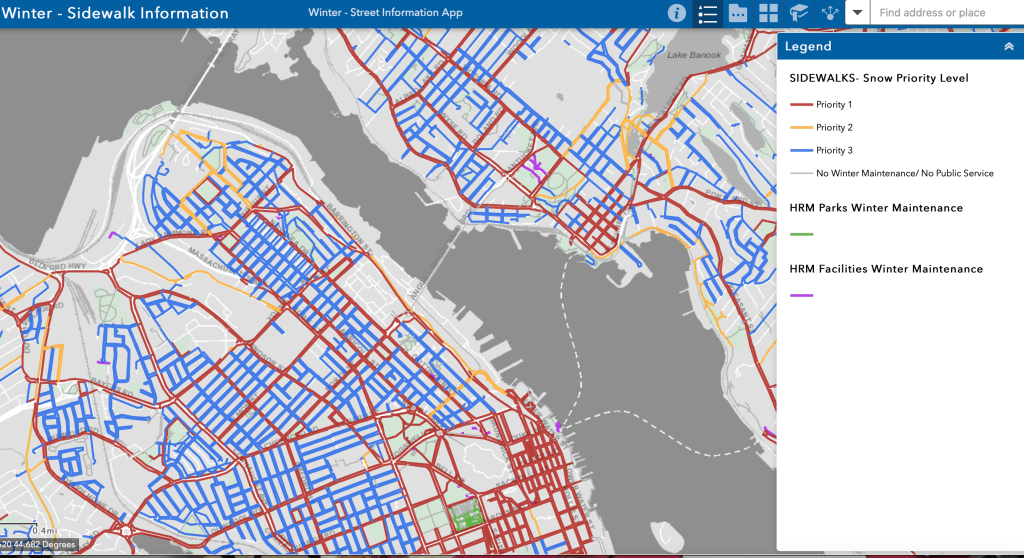
A section of the sidewalk snowclearing map for Halifax, showing that almost every street in the city is cleared.
Of the five comparison cities in St. John’s’ own consultation, four aim to clear all or nearly all their sidewalks and the fifth has a goal of 62%. Not that other cities are perfect but at least they have higher goals and allocate more resources. People often compare St. John’s to Halifax so let’s start there. In terms of snowclearing, Halifax gets about half as much snow yet they invest about twice as much per km in sidewalk snowclearing. They also clear bike lanes with the same priority level as sidewalks: Priority 1 within 12 hours, Priority 2 within 18 hours and Priority 3 within 36 hours. They have a lot of the same challenges we do (hills, freeze and thaw cycles, old buildings and infrastructure) and were one of the comparison cities in the St. John’s’ 2014 snowclearing consultation.
Toronto
Photo of a Toronto sidewalk plow operating in a very narrow area, with a statement on the policy described below.
Toronto is a less obvious comparison than Halifax but it’s of interest because until recently the city cleared suburban sidewalks but not the downtown, on the grounds that downtown sidewalks had so many obstacles and narrow areas that plows couldn’t get through (an excuse we often hear in St. John’s). However, it changed its policy recently and now clears all sidewalks, with preliminary clearing done within about 13 hours and further clearing as needed over the next few days. They bought special small articulated plows that can get past obstructions. Areas they still can’t do are manually cleared.
Quebec City
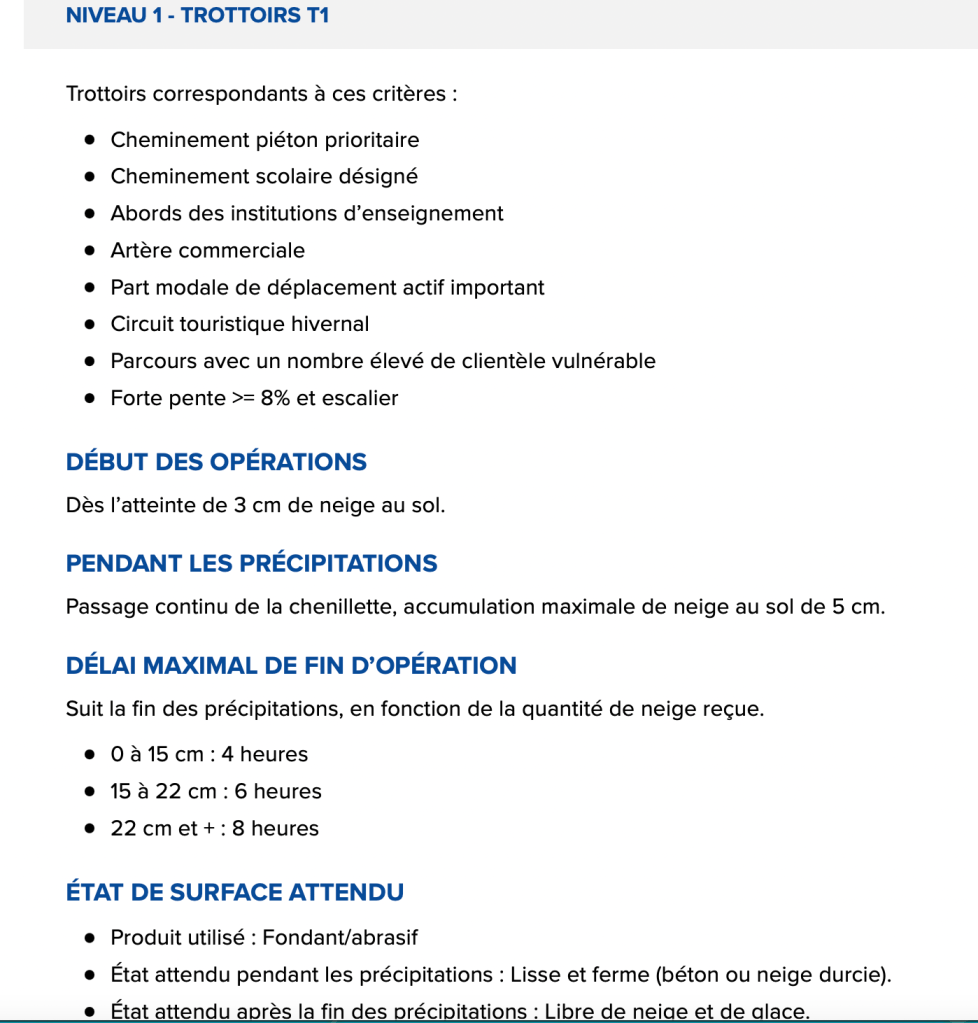
Screenshot of Québec City’s Priority 1 policy, as described below. Their plan was so detailed it couldn’t all fit into a single screenshot.
This is just Priority 1 (!) for Quebec City (also a comparison city in St. John’s’ consultation of 2014, with a similar snow load, many hills and narrow streets). Top priorities include school routes, designated active transportation routes, routes used by high numbers of vulnerable residents, steep streets and stairs, and tourist areas as well as main arteries. Note school routes, not just a drop off area in front of the school as in St. John’s. They plan for children to walk to school safely. They aim to have all Priority 1 sidewalks clear to bare pavement within 4 hours of 0-15 cm snowfall and 8 hours of 22 cm+ snowfall. Although these are their top priority, they also aim to have every sidewalk in the city done within the same timeframe, but to a lesser standard.
Moncton
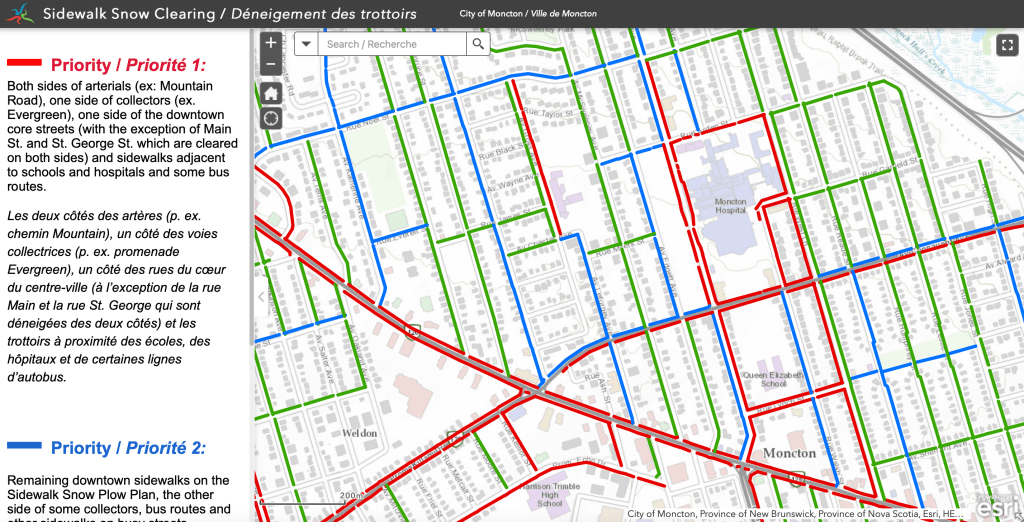
Map showing a section of Moncton’s sidewalk snowclearing program, with virtually all sidewalks cleared.
This is an enlarged section of Moncton’s sidewalk snow clearing map. You can see that they clear nearly all the sidewalks in the city. Moncton is a comparable size city to St. John’s with similar snowfall levels and plenty of freeze and thaw cycles yet they aim to have all Priority 1 sidewalks cleared within 24 hours and to finish all Priority 3 within 3 days. Priority 3 are residential and cul de sacs, streets St. John’s would never dream of clearing at all.
Waterloo
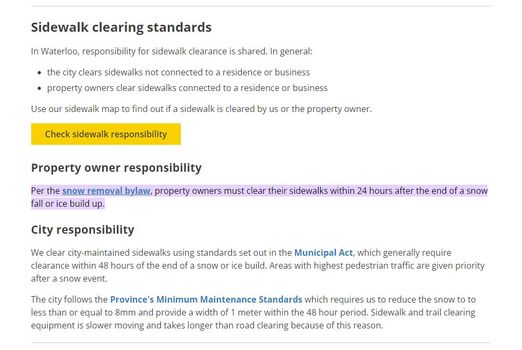
Screenshot of Waterloo’s policy as described below.
This post is a version of a thread I put on Facebook a few days ago. A commenter on the thread added the city of Waterloo with this image and statement: “I walked to work Friday morning near Bowring Park/Cowan Heights and the walk was disgustingly treacherous. I’m amazed the city has a timeline of 4 to 7 days. I looked up what my home city of Waterloo has as their timeline and their website states 24 to 48 hours which really isn’t that great even compared to some other cities. It made me really realize what I took for granted during my university years and this combined with the low-density living are big reasons why I am planning to leave soon.”
One huge challenge to walkability and accessibility in winter is the way property owners and private contractors dump snow cleared from driveways and parking lots onto sidewalks. This was discussed recently at the St. John’s: The Winter Unfriendly City Facebook group. I’m going to summarize the discussion here so it can be found again later.
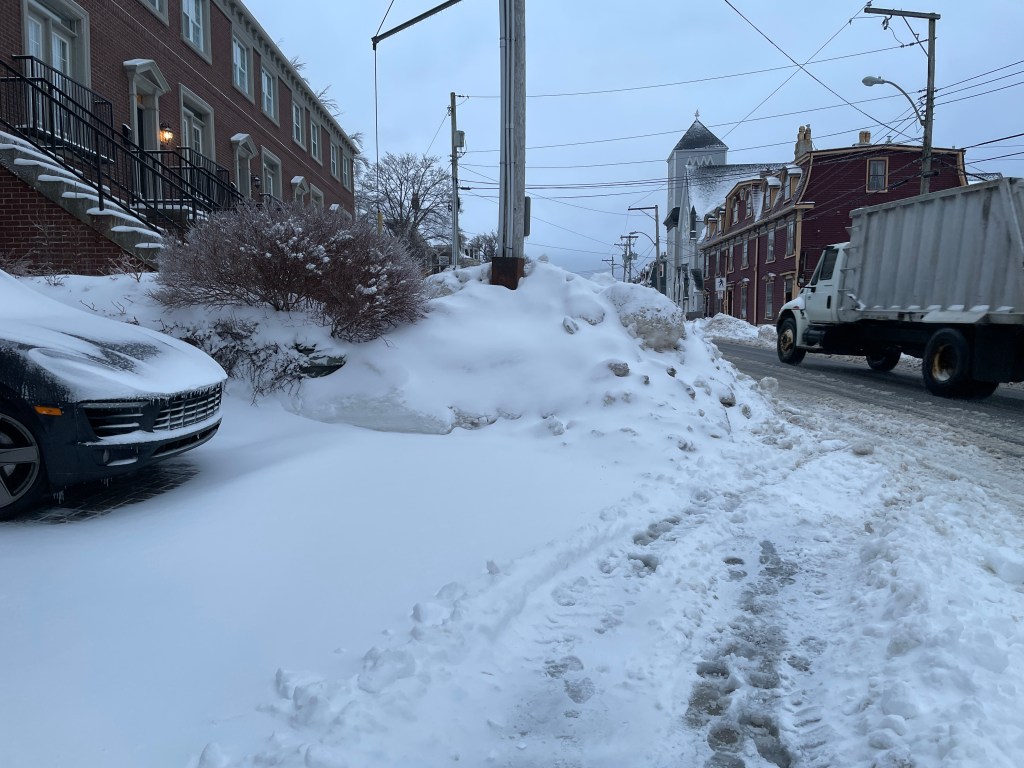
According to Councillor Maggie Burton in this thread, this is permitted as long as the sidewalk isn’t part of the City’s sidewalk snowclearing program. This means it’s permitted on about 90% of sidewalks! However, it’s also very common on sidewalks that are part of the program, as in this photo, showing a huge mound of snow on the sidewalk between 56 Queen’s Rd. and 46-54 Queen’s Rd. where the building owners on both sides have cleared their parking areas onto the sidewalk between them.
Yes, I know. It doesn’t look as though there’s a sidewalk there at all but this is actually a sidewalk that the city is supposed to clear and actually does usually clear within a day or two of a snowfall. But then this happens and pedestrians are forced to walk in the street where that truck is.
People frequently complain to the city about this practice and are told that nothing can be done unless they can prove who did it, as in not the property owner but the actual person who put the snow there. So the onus is on the complainant to either track down the property owner and find out who did their snowclearing (if they can be tracked down and are willing to share that information) or to see the person in action and photograph them or get their license plate if they happen to have a vehicle. It also requires constant monitoring, documenting and complaining to the city on the part of sidewalk users, as well as the unpleasant possibility of confrontation.
So, what are the by-laws that apply here?
At the city’s snowclearing priority page it says, “St. John’s Snow Removal regulations require properties adjacent to designated downtown streets to keep their sidewalks clear of ice and snow.” So “properties,” not “persons.” But the actual by-law (1098) does use the word “person” in some places and “abutter” in others. An “abutter” is defined as a lessee, owner or occupant of a property and, on some specific downtown streets, abutters are required to clear snow from sidewalks in front of their properties. But in the case of people depositing snow on sidewalks, the word used is “person.” The same by-law states, “No person shall deposit snow or ice upon any street or sidewalk which street or sidewalk is cleared of snow or ice by the City” and “No person engaged in removing snow or ice from any property or other premises shall do so in any manner that obstructs vehicular traffic on a street or pedestrian traffic on a sidewalk.” So “abutters” are responsible for removing snow in certain areas but “persons” are responsible for not blocking sidewalks. Can this wording be changed? Councillor Burton said on the Facebook thread that she would look into it so I’ll update later when we have an answer.
The bigger question is why these by-laws aren’t enforced, considering that these piles of snow force people to risk life and limb by walking out into busy streets. An ATIPP in 2020 revealed that between 2016 and 2020 not a single fine was levied to enforce by-law sections 7 and 8 against blocking sidewalks. Still, changing the wording of the by-law would at least mean the city would have to think about the law, and would no longer be able to use this particular excuse for doing nothing.
Updated Sept. 27: It’s too late to mail in your ballots but it’s not too late to vote! Tomorrow, Sept. 28, is Election Day and you can either drop off your ballot at a designated site or register to vote in person at the site. All the information you need is at this link.
If you’re concerned about climate change and/or getting around the city without a car, here are my thoughts:
Mayor Danny Breen and Deputy Mayor Sheilagh O’Leary have already been acclaimed so I won’t discuss their records here except to say that I think they will work collaboratively with a council that is really committed to responding to the climate emergency that the City has declared.
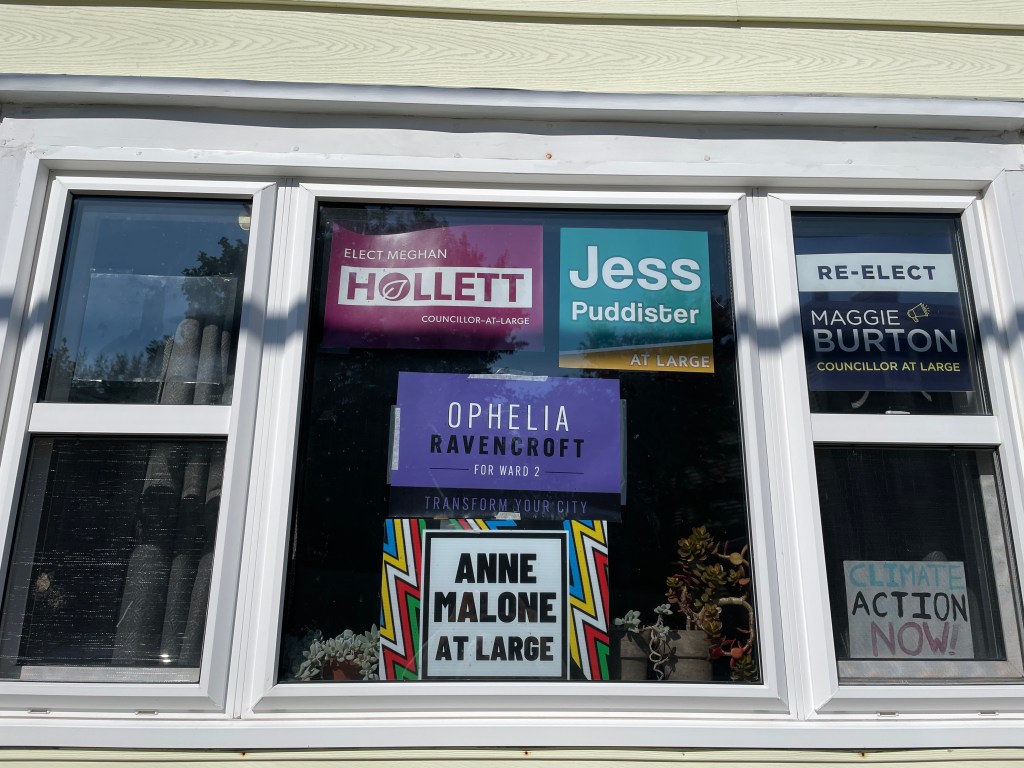
I do live in Ward 2 and I’m supporting Ophelia Ravencroft. How could I not when her number one priority is to fix our “horribly uncleared sidewalks in the winter that are wildly unsafe, wildly inaccessible, and that badly exacerbate our city’s inequalities”? Like Mark Nichols, she really gets the key role of transportation and has been very explicit about that. You can see her responses and those of two of the other three candidates to questions on climate change and transportation as well as other things here. (Art Puddister did not respond but last time he was a councillor he did his best to turn bike lanes into parking so I think that’s all we need to know about him.)
Ward 4 incumbent Ian Froude has already been acclaimed so there’s no need for more discussion but he has shown in the past that he is a very strong voice for accessible active transportation and climate. He and Maggie Burton were the only two members of Council who, last winter, voted against a budget that did not support improved sidewalk snowclearing. He has also taken a lead on building active transportation infrastructure as well as on the city’s declaration of a climate emergency.
There are many candidates for the four at-large positions but I didn’t really hesitate on who to vote for here as there are four candidates who really stand out and whose records I’m already familiar with. They are Maggie Burton, Jess Puddister, Anne Malone and Meghan Hollett. Here’s a short summary of my reasons for supporting them.
As a geo-environmental scientist, Jess Puddister probably has more professional expertise on the climate crisis than any other candidate. She has years of experience working with municipalities and other organizations on climate change solutions. Her response to questions on transportation was: “The City has an obligation and responsibility to make it possible for people to have a good quality of life in St. John’s without having to own or use a car, and to mitigate climate change by reducing the number of cars and car trips needed to get around the City.” She also noted that “Taxpayers often don’t realize but they’re subsidizing car culture through planning and budget choices at the Council table. We need to make a culture shift.”
Anne Malone‘s position is that she wants to be the accessibility councillor so she has really focussed on that issue but I know her quite well and feel that she would support any initiatives to address climate change. She has worked for many years on making St. John’s more accessible with a particular focus on sidewalk snowclearing. Anne is absolutely a mobility and climate justice candidate. She was an invited speaker at the last Fridays For Future climate strike along with the other three at-large candidates mentioned above so they obviously think so too.
If we elect the candidates I am recommending, I believe we will see a massive shift at City Hall towards climate justice as a framework for decision making and accessible active transportation as an essential aspect of responding to the emergency.
Description: Cathedral skylight with sunlight shining through. Photo by Tony Hisgett from Birmingham, UK, License: CC BY 2.0 , via Wikimedia Commons.
The summer before Covid hit I had the chance to re-visit the Catholic Cathedral in Liverpool, England–one of the most beautiful buildings I’ve ever seen. I’d been wanting to go back ever since I first saw it in 1975 when I went with a friend who was studying architecture at the University of Liverpool. We had a heated discussion about whether the Cathedral, then almost new, should ever have been built. He argued that the money should have been spent on public housing. I said there was value in a sanctuary that anyone could go to for rest and spiritual sustenance. As I walked around it again so many years later, through shafts of sapphire, crimson, green and gold as the sun pierced the stained glass, listening to the soft voice of the elderly Irish-accented guide explaining what it meant to his community, how everyone contributed what they could to build it, the symbolism of this place of solace on the site of the Victorian workhouse where so many Irish immigrants to Liverpool lived and died, I still thought I was right.
That was a year and a half ago. Last summer at the same time we were all staying home and finding solace in our own communities. I started out doing a lot of hiking along our spectacular coastline but then I got plantar fasciitis and it was too painful to walk very far. However, I could still cycle as the injury was on my heel, and so my bike became my mobility device and the Waterford River Trail my sanctuary. I rode there almost every day: along the waterfront and into the woods where I could feel free and happy away from cars and the noise of the city. The river and the trees opened up vistas of delight: I stopped here and there to picnic or watch small birds and animals, as the wild raspberries and apples gradually ripened, the river flowed through woods and meadows to the harbour, and the leaves changed with the seasons from pale to brilliant green and then to the golds and reds of fall.
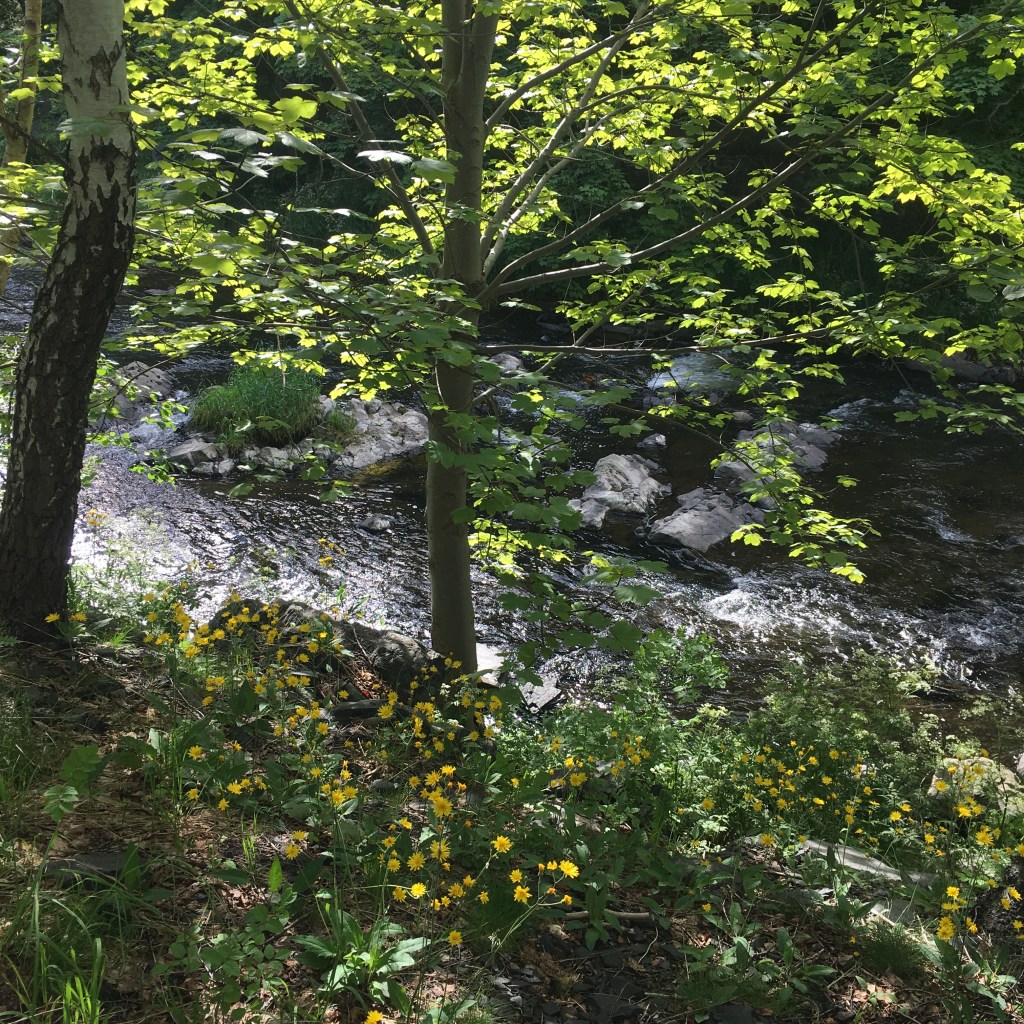
Description: Sunlight on birch trees, yellow flowers (coltsfoot) and water running over stones. Photo by author.
What does the idea of sanctuary have to do with the St. John’s Bike Plan? Last week I attended a focus group on the Kelly’s Brook Trail, the first project in the bike plan. I can’t quote people directly because of confidentiality but the group included participants with many different perspectives, some for the trail and some against (though apparently more strongly opposed to the proposed future projects involving the Rennie’s and Virginia River trails). One person, who seemed averse to the bike plan, said that the fundamental problem was car culture: the fact that the city makes no provisions for safe cycling and very few for getting around, especially in winter, by any means other than a private vehicle. Another spoke of how the Rennie’s River trail is a sanctuary that should not become a commuting corridor.
I support the Bike Plan because we have nothing else, because we desperately need ways to get around outside the car–both for commuting and for sanctuary. I don’t think those things are necessarily separate. For example, someone mentioned in a social media thread recently how aggravating it is that the paths through Bannerman Park are cleared of snow in winter yet the sidewalks aren’t. Someone else responded that children walk through the park to school as a safe off-street route. I would add that it also gives them a peaceful and beautiful aesthetic experience every day as they travel back and forth, and they need that as well as basic safety. Active transportation is kind of a utilitarian term but part of its value is that commuting can be good for the soul as well as the body.
We need routes and trails that are accessible to all: where someone with a guide dog can safely walk without the dog being traumatized because there is no safe route to lead them on; where a person using a wheelchair or a modified bicycle can enjoy the kind of sanctuary I found last summer along the Waterford River; where children can travel safely to school.
How do we balance these things? We need much more than a bike plan. We need an overarching vision and concrete objectives for all forms of transportation. We need to prioritize active transportation because it’s good for the climate as well as for our health and happiness. We will all need to make compromises: to find ways to make the river trails accessible to mobility devices; to consider whether parts of these trails might be developed into commuter zones while other sections are not; to accept that some cycling routes will be along protected street corridors, which won’t be so peaceful but will leave some spaces for slower enjoyment. We need a whole network of active transportation commuter routes and recreational trails, and we need to think about how they will all fit together, how to ensure they are accessible, and how to maintain them year round. We need this because mobility is a human right; because we have to protect our planet; and because now, more than ever, we need sanctuary.
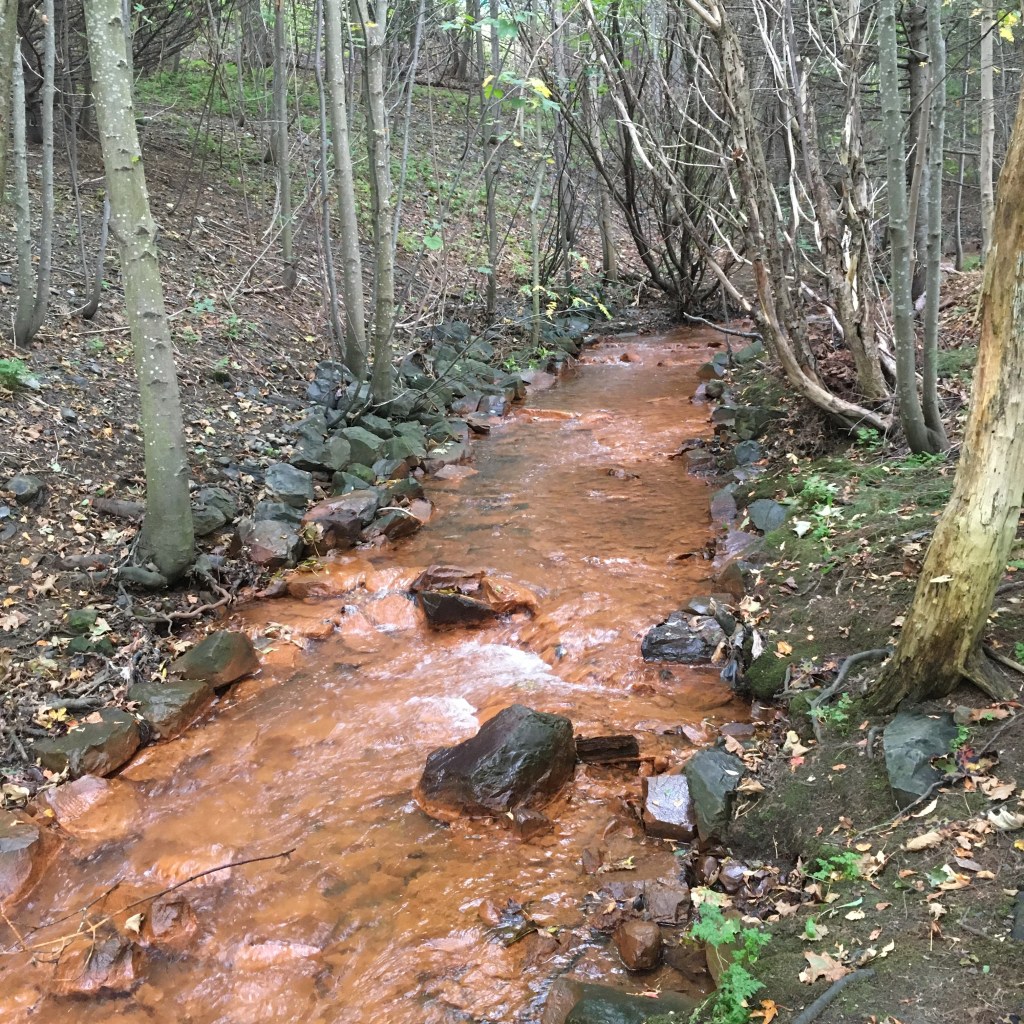
After the Council decision on sidewalk snow clearing to, as Emily Deming put it, “force whole segments of the population into isolation for months of the year” (or into life threatening situations when they venture out), we needed some good news so here it is. I took photos last summer for a post about the Kelly’s Brook Trail but then never had time to write it. Since it was announced last week that the trail will go ahead, this seems like a good time to do it. The photo above is of the short section of the actual brook that is above ground, near St. Pat’s Ball Park. Most of it is underground in culverts, roughly parallel to and just north of Empire Avenue, between Mundy Pond, where it begins, and Rennie’s River where they join near Portugal Cove Rd. The rusty colour is presumably from the culverts. I’ve always felt sorry for this neglected and ill-treated little brook. However, this post is about the trail so I’ll leave that topic for later.
The proposed trail–which mostly already exists but will be upgraded to a multi-use one–will run 4.9 km. from King’s Bridge Rd. to Columbus Dr. It’s a very significant first stage in developing a network of cycling trails around the city as it passes near several different neighbourhoods and workplaces. It’s also wonderful news for active transportation in general. It will make it possible and even enjoyable for people to commute safely by bike, wheelchair, or with a stroller. Running east-west, it’s almost flat with just a very slight incline as you head west, easy pedalling for cyclists in that direction and then you can practically coast all the way back. I think I said the same thing about the Waterford River Trail but that’s because, despite all the hype about how impossibly hilly our city is, it isn’t at all when you go east-west.
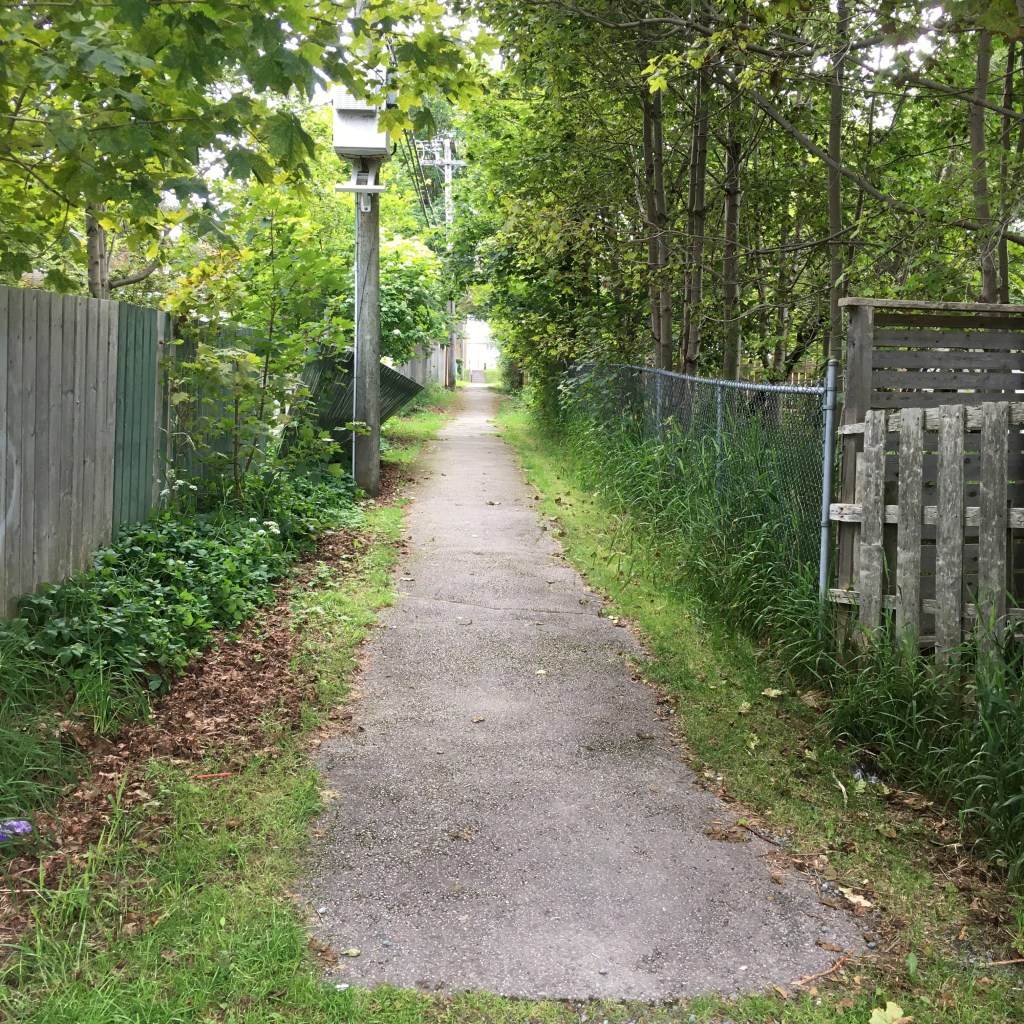
I started the trail at Portugal Cove Rd. This is one of the prettiest sections as it runs along the open part of the brook, through birch woods. However, it isn’t very easily accessed by bike as it has stairs at both ends of that section–which obviously makes it completely inaccessible by wheelchair. I should also mention that it isn’t yet designated as a cycling trail but I rode it anyway. There were very few people on it, probably because it isn’t the prettiest of trails and it’s also quite chopped up with some sections hard to find. However, it was fun to explore, it runs mostly through green spaces, and once it’s developed it will be a fantastic way to get across the city.
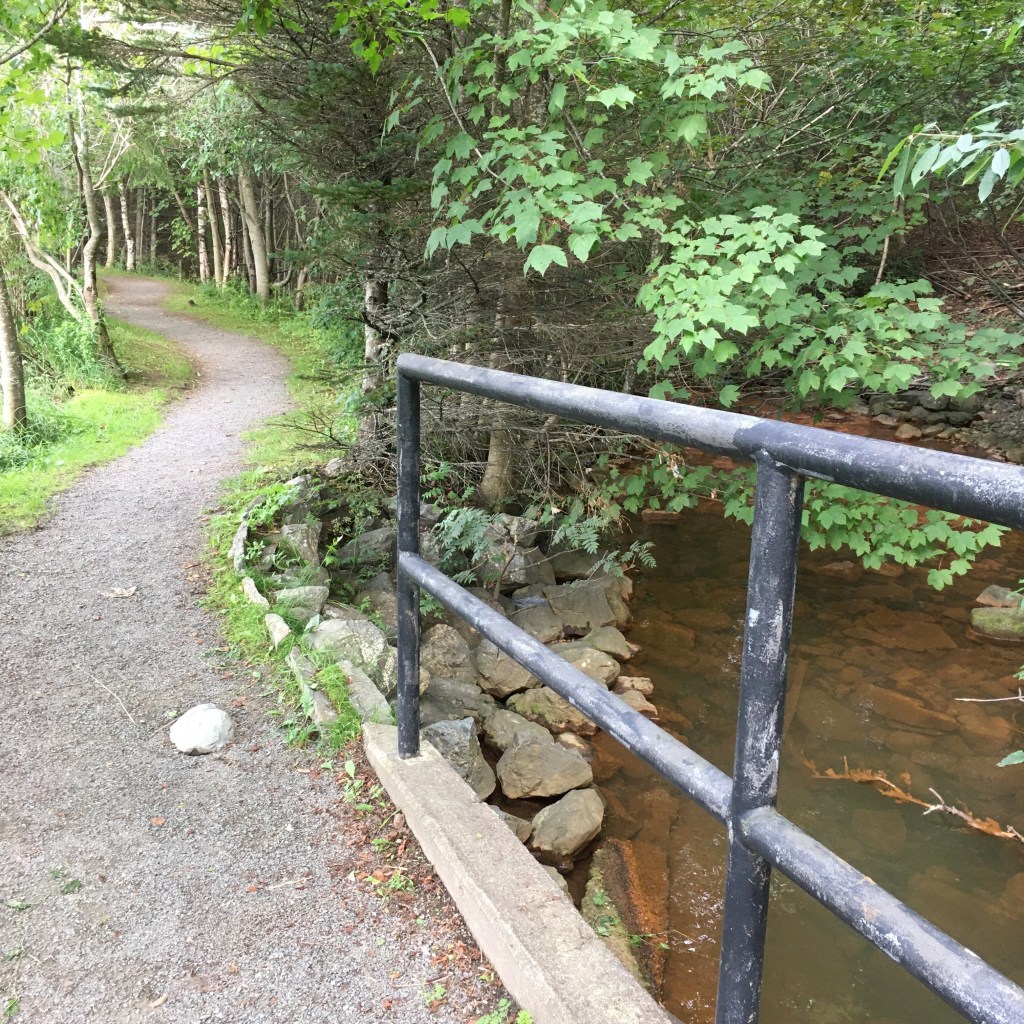
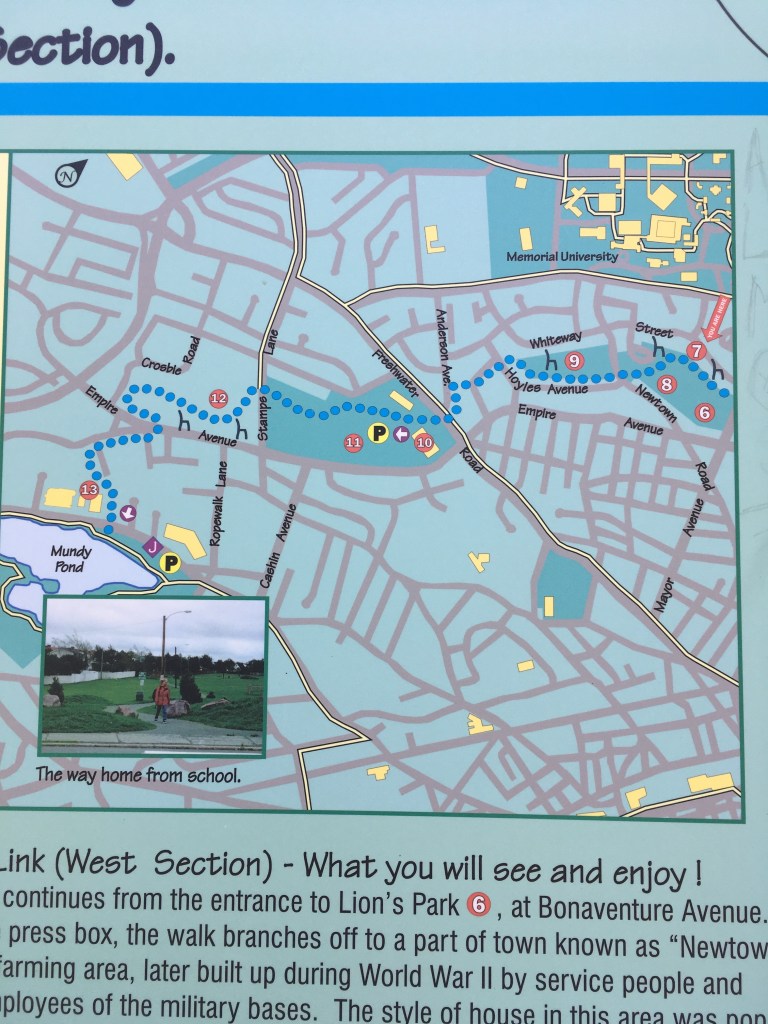
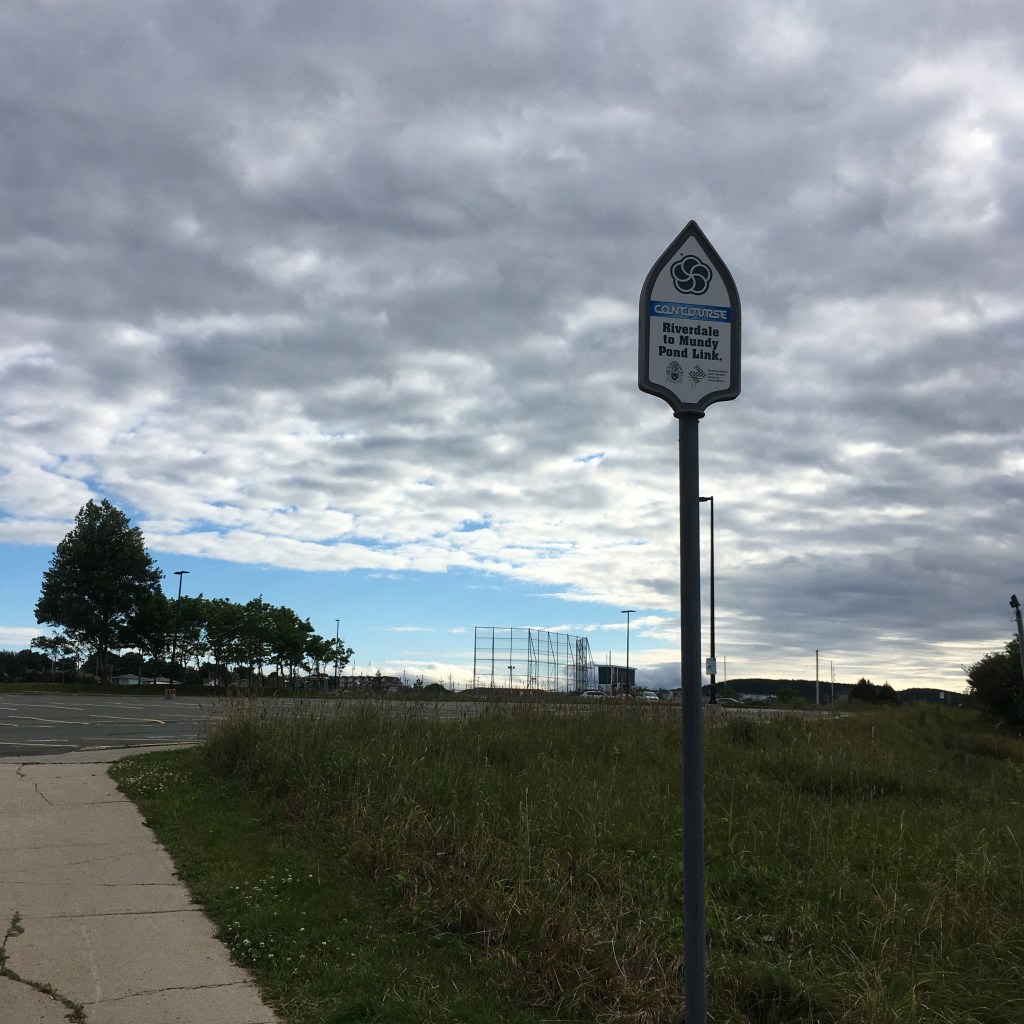
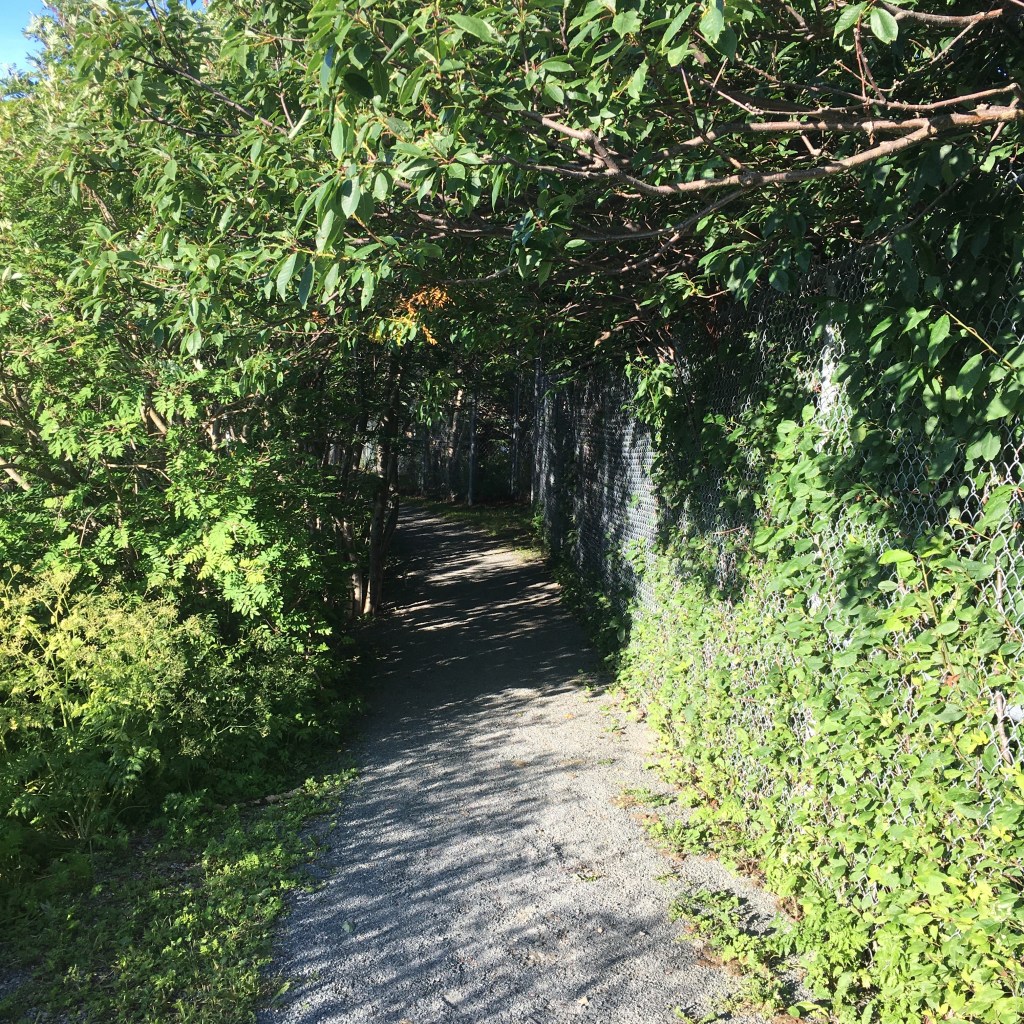
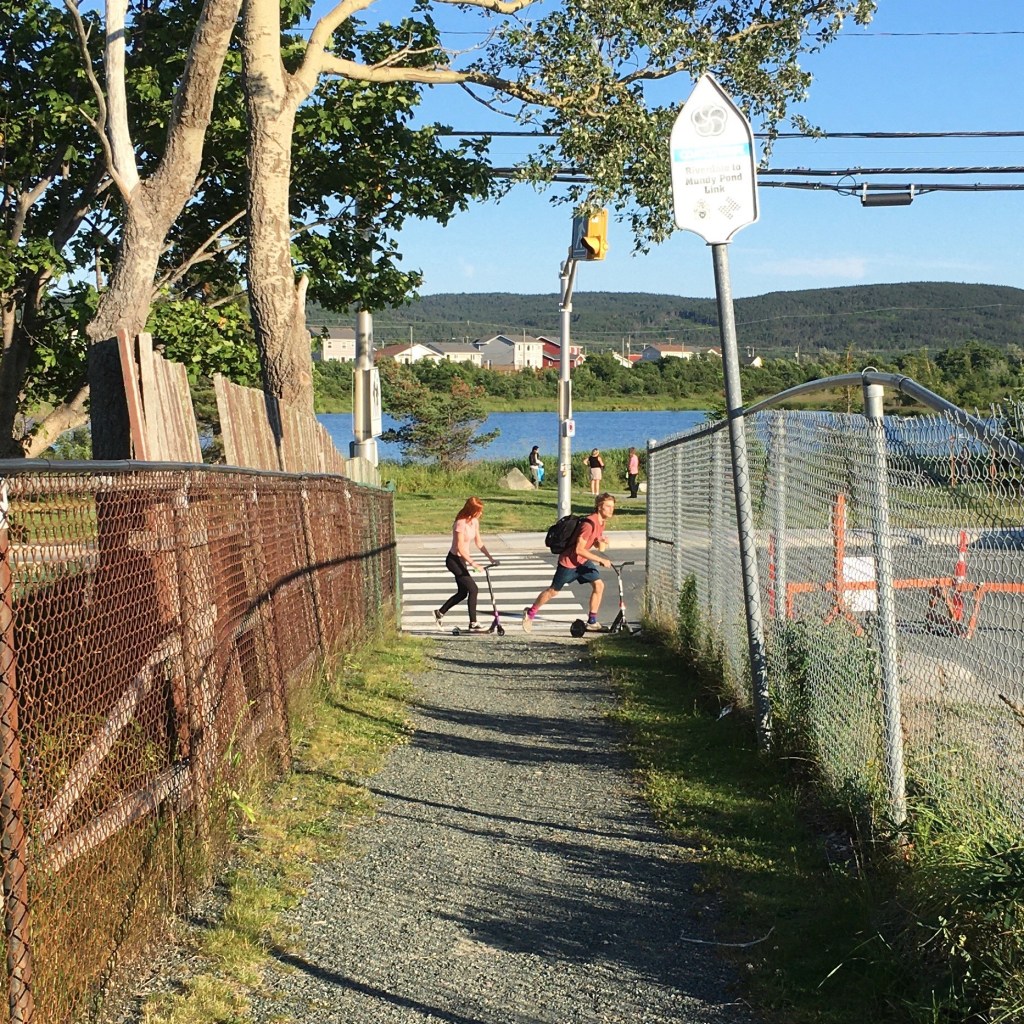
I took a lot of photos, thinking they’d help me map the route for this post (a couple of the photos are even of maps!) but I still can’t remember all the twists and turns well enough to give instructions. So here’s a set of pictures to give you an idea what you’ll see along the trail but I suggest you just explore it someday when you have lots of time and be prepared to get lost occasionally. It is part of the Grand Concourse so you can also find a map there. Just click on the map at this link and then click somewhere near Portugal Cove Rd. and Empire Ave. They call the route the Riverdale to Mundy Pond Link but it is essentially the Kelly’s Brook Trail.
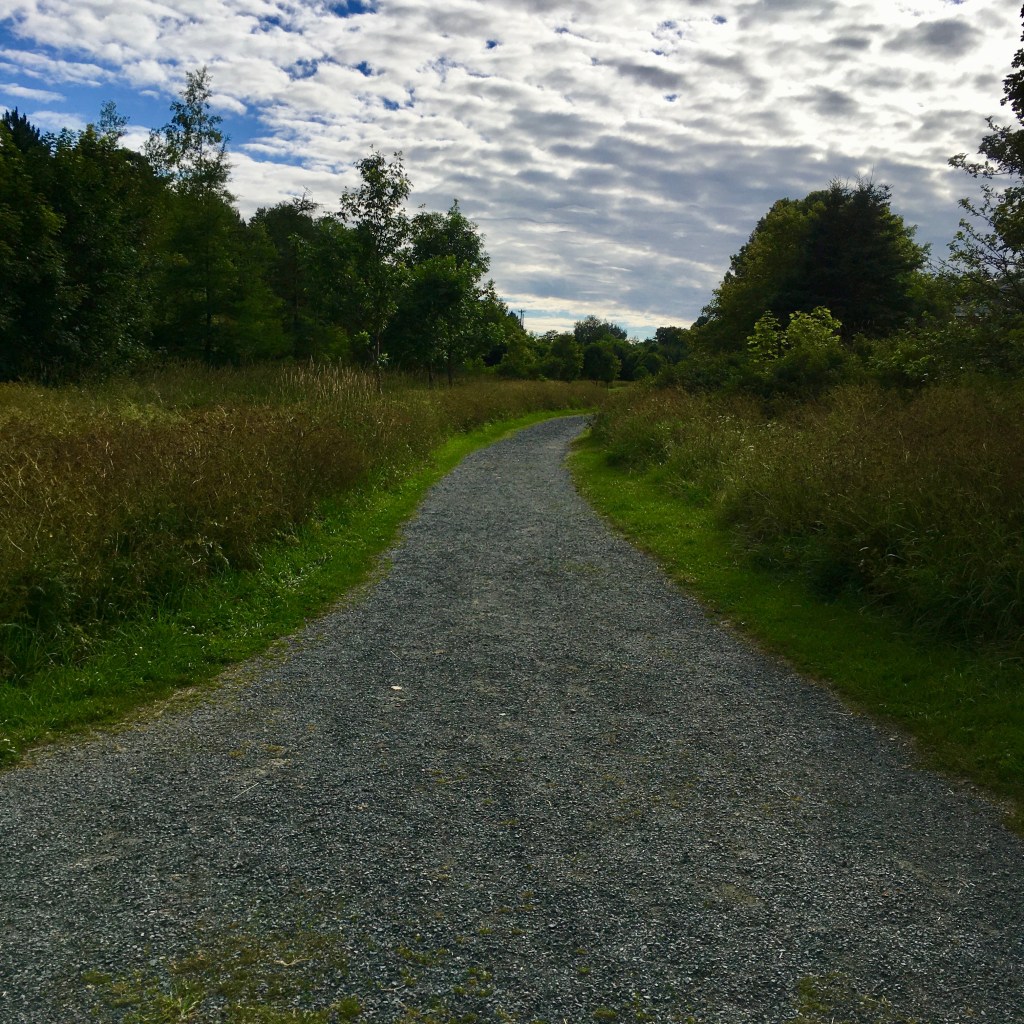
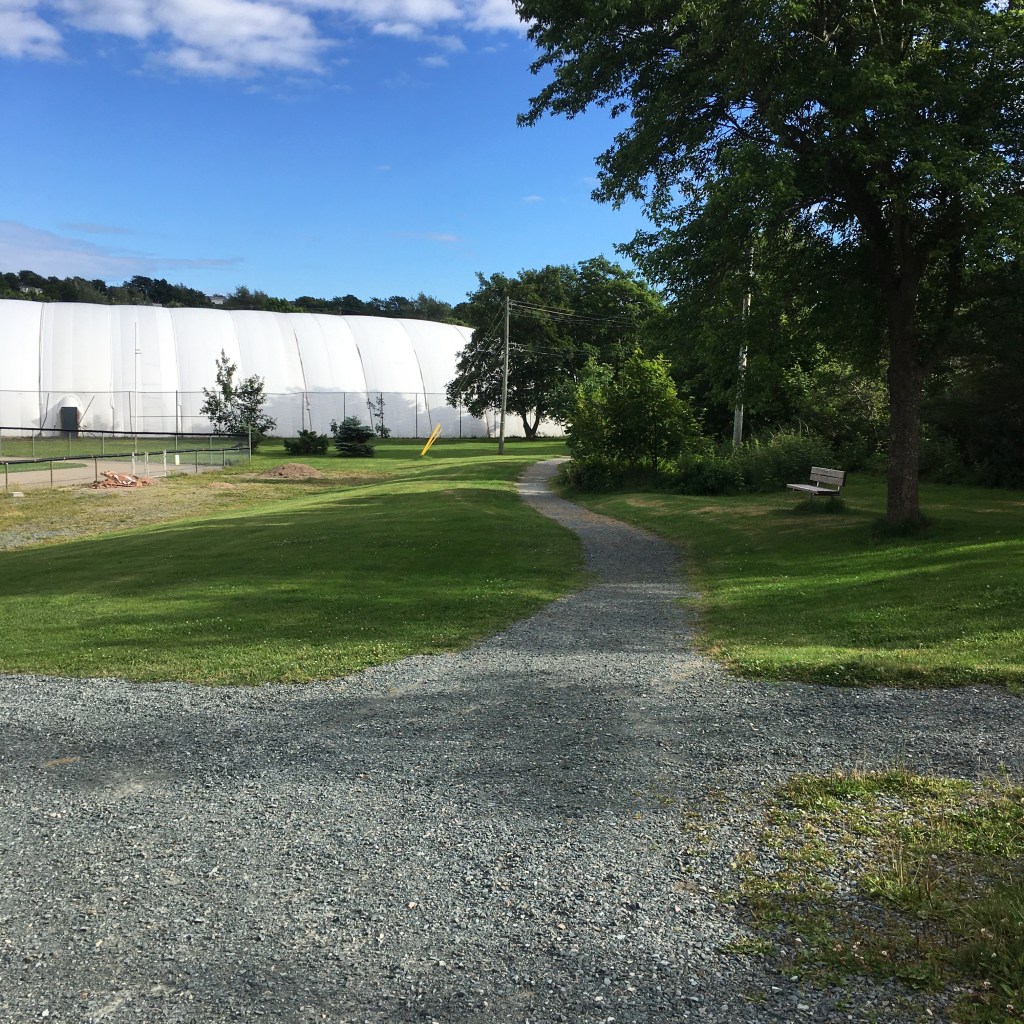
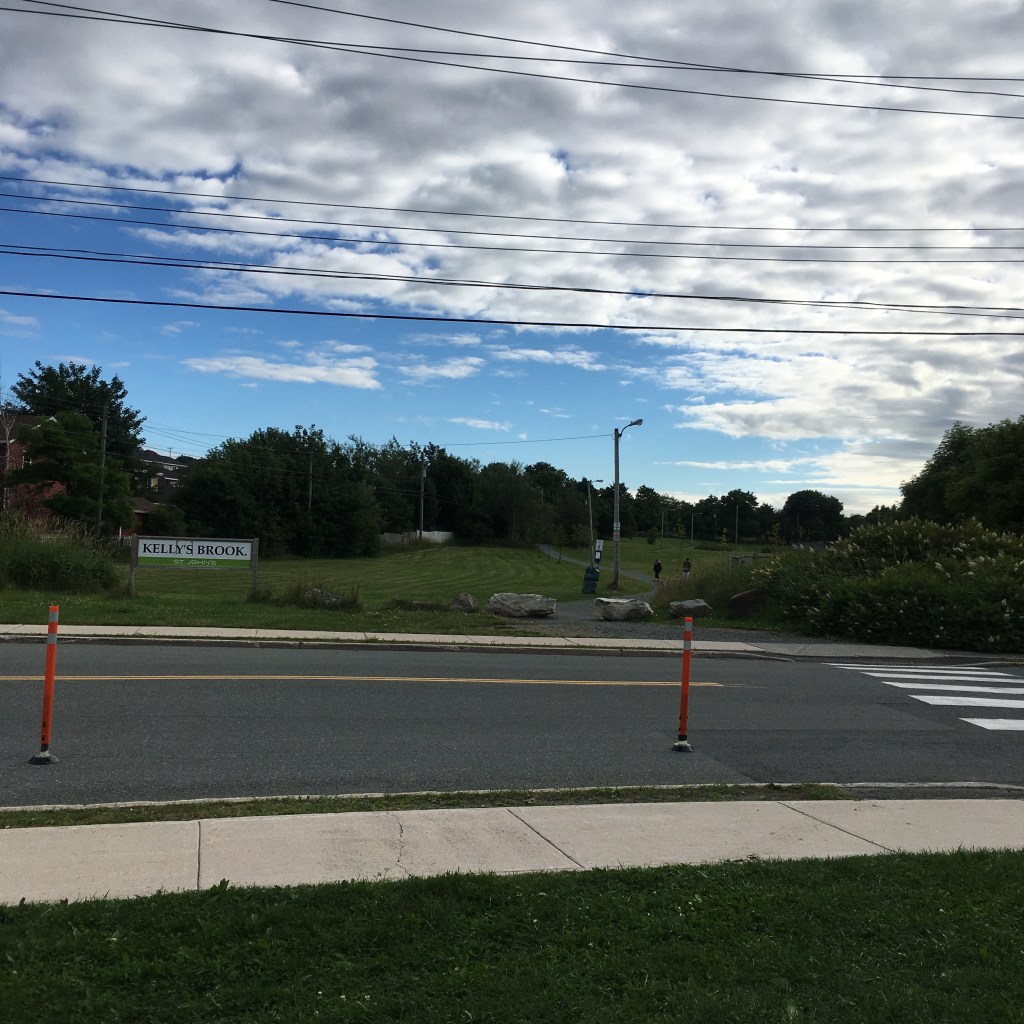
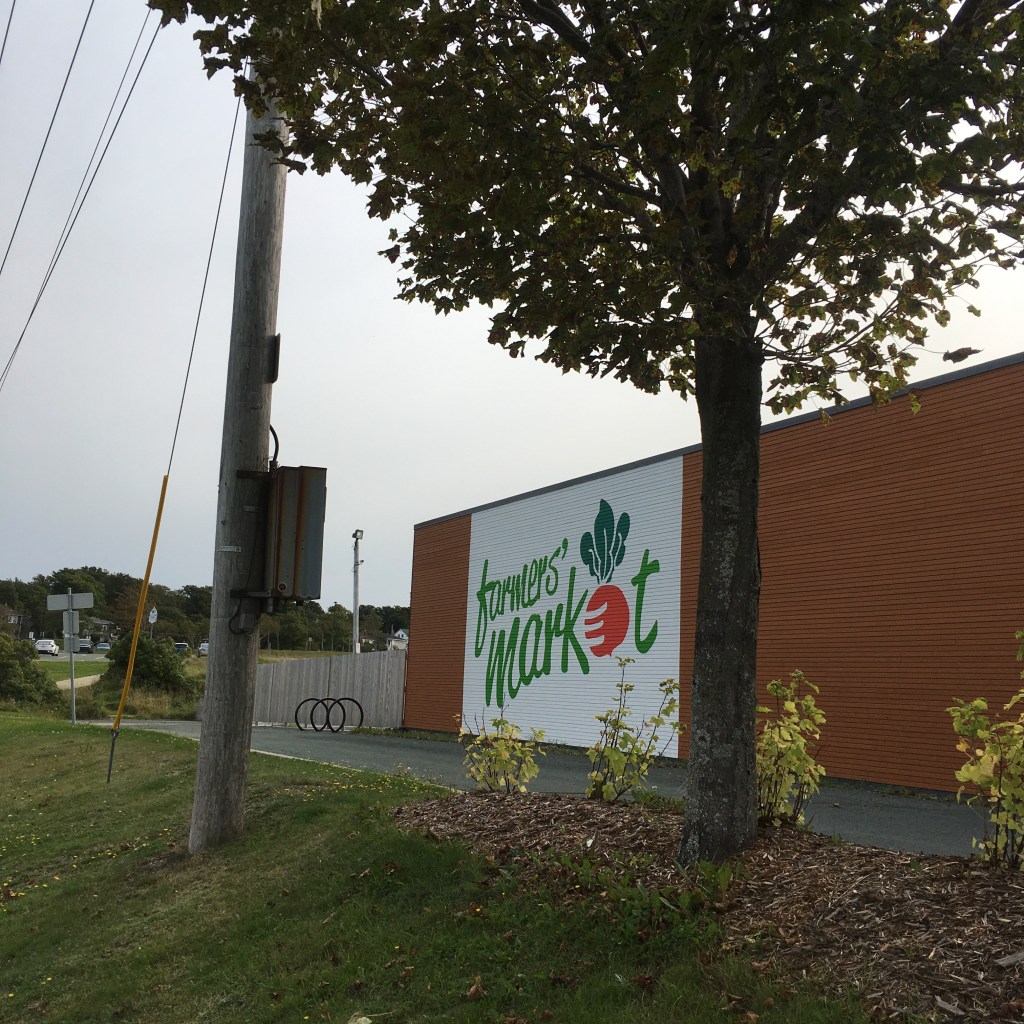
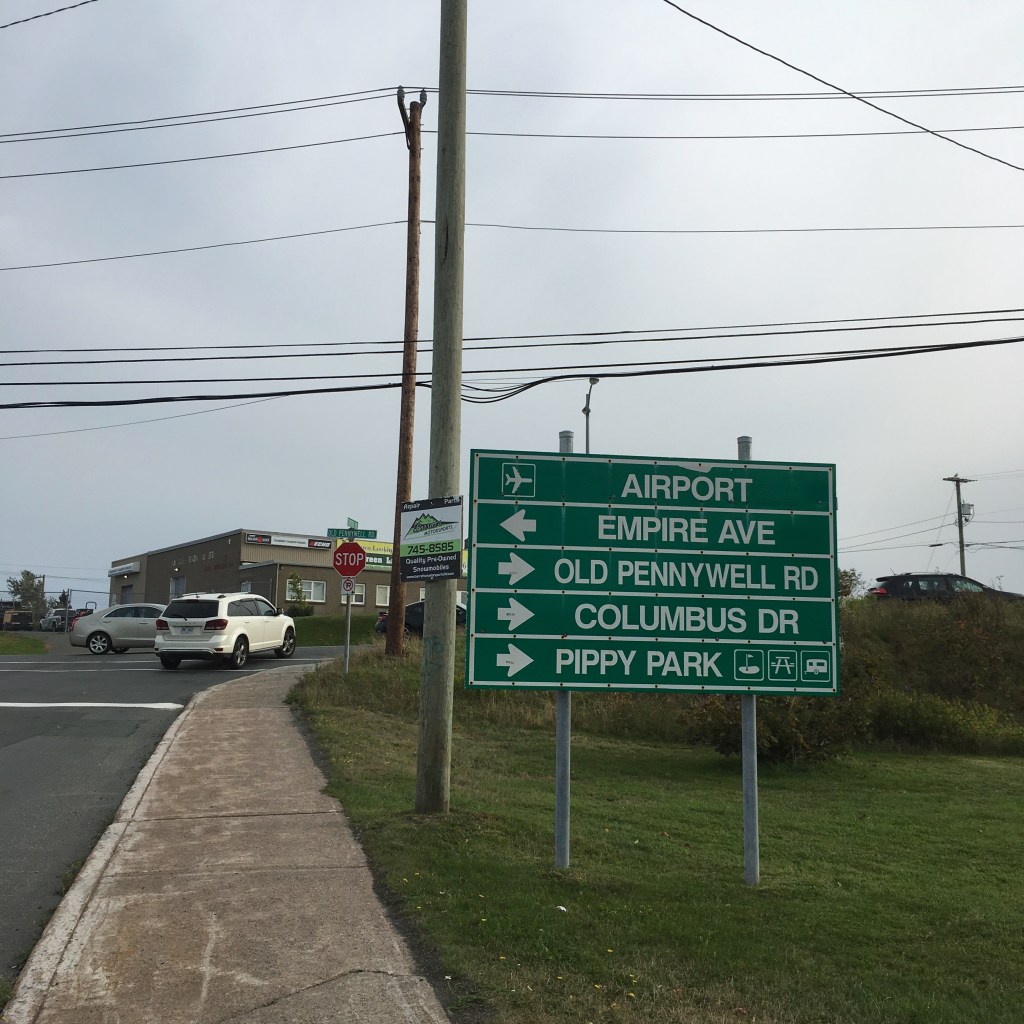
Exit the first section at Carpasian Rd. Cross the road and enter near the Elk’s Club then through the valley to Bonaventure. The brook runs underground from here on.Follow the trail past that white bubble tent thing on the other side of Bonaventure. Cross Newtown Rd. and enter the trail again. There’s actually a Kelly’s Brook sign on this bit. Also note the “candlesticks” marking the ill-fated Covid extra-space-for-social-distancing experiment of earlier in the summer. I’m not even sure if they were meant to be for pedestrians or cyclists, or both, but I do know they didn’t work. The new trail will be a million times better! The trail passes countless playing fields and little wildflower meadows tucked in between residential areas.Through little laneways and more playing fields then via Graves St. to the Farmer’s Market at Freshwater (note bike racks–they are popping up all over the place!)And yet more playing fields on the other side!I can’t even begin to give clear instructions for the part after you get past the last of the playing fields and cross Stamps Lane. You go through a series of parking lots and little laneways, cross at old Pennywell Rd. and Empire Ave, more of the same on the other side and end up at Mundy Pond if you’re lucky. The new trail will go to Columbus Dr. but this one connects Mundy Pond to the Waterford River Trail from here so that’s what I did. This is already a pretty long post though, so I’ll save that for another one. Have fun exploring!
When I first read City Staff’s recommendation on sidewalk snow clearing, I thought I must have misunderstood. I read it again more carefully and realized I had not. They looked at six different options for improving service and then made the recommendation to do absolutely nothing. In their words:
“that Council maintain the status quo. Given future anticipated budget challenges, enhancing the level of service for sidewalks is not recommended. The minimal cost option to produce a noticeable difference to residents is 700k per year which is not budgeted.”
You can see the full document prepared by staff and the details of the options on pp. 15-19 at this link.
In response, Councillor Ian Froude told council that he had heard from people with disabilities and from the Human Rights Commission about people’s experiences in winter and that “those things weigh on me heavily.” He commented that access and accessibility are human rights and also noted that the comparison cities in the KPMG Report (commissioned by the City in 2014) spend more per kilometre, despite less challenging conditions in some cases. He introduced a motion not to follow the staff recommendation but instead to make significant changes based on some of the options staff proposed and then rejected. After discussion, the single motion was broken down into three separate ones, which I summarize here with the vote results in brackets:
The first motion had four bullet points:
Staff to review priorities/efficiencies and put forward a plan
Address quality of clearing
Enforce existing by-laws re not blocking sidewalks, etc. (It was noted that this would be a “quick fix.”)
Re-prioritize and free up resources and funds from side roads to sidewalks (Carried)
The second motion was that during budgeting for winter 2021/2022, the City would consider implementing Option 6 from the staff recommendations–confusing, I know. They presented six different options for things that could be done, with the sixth one being the most expansive and expensive ($800,000 capital, $450,000 operating) but then recommended not doing any of them. After discussion, this motion was modified to considering all six options during the budget process next summer. (Carried)
The third motion was that for the coming winter, options 2 and 4 would be implemented. These combined options would have cost less than option 6 but still made a significant difference in the quality of sidewalk snow clearing. (Defeated) (Note that, as shown in the screenshot at the beginning of this post, this motion was supported by Councillors Froude and Burton and Deputy Mayor O’Leary.)
To backtrack and give some context, the meeting began with a presentation by Dr. Dan Fuller, Canada Research Chair in Population Physical Activity, about the BEAP Lab research that found fourfold economic returns on $3 million annual investment over ten years, using a model based specifically on St. John’s. He also highlighted health benefits and noted that currently only about 4% of our citizens walk (this includes just walking to the bus stop) and recommended that we set a target. Some cities have 10-12% as a target. (See Asia Holloway’s report on this research at this link.) Council seemed very supportive of the idea that walkability is important. Sample comments:
Creating density and walkability is “good for business development,” “good for the city and good for the population.”
Mayor Breen
“To attract people we have to make the city more walkable and more accessible.”
Councillor Hanlon
In winter, crosswalks, intersections and bus stops “need to be clear with open spaces for access.”
Councillor Hickman
Yet they all voted against increasing the budget, as did Councillor Stapleton, who is Team Lead for Inclusion. Other councillors who voted against also seemed supportive during the discussion. Councillor Lane noted how fundamental mobility is and that “a pedestrian friendly city can help solve a lot of problems.” He recommended that the city “shift funds from mechanized access on side roads to better pedestrian access” (this was one of the bullet points in the first motion, which was carried.) He also emphasized that we should follow the recommendations of the KPMG Report. Councillor Korab asked “Do we need to increase the budget for sidewalk snow clearing?” and answered his own question: “In all likelihood, yes.” He said that he was “open to an increase.” Councillor Collins added, “It would be fairer to do all the sidewalks in the city.” Yes, he did actually say this, though I’m not sure he truly thought that was a realistic option. I think his point was that the downtown gets better clearing than elsewhere in his opinion. However, four of the five comparison cities in the KPMG Report actually do clear all their sidewalks and the fifth does 62%. St. John’s does 23%. All five comparison cities also start clearing sooner and have higher standards in general.
A few other things to note about the discussion and vote: Councillor Burton and Deputy Mayor O’Leary spoke strongly in favour of increasing the budget, with Councillor Burton emphasizing that, “Active transportation is a must have, not a choice or a nice to have.” She also mentioned that people without access to cars currently endure injuries, loss of opportunities and income, and inability to access transit. Clearing snow for pedestrian access has been severely underfunded for many, many years. The City currently has a surplus of $22 million and this was achieved in some part at the expense of pedestrians. Some have lost their lives or become severely disabled because of it. There was also an important exchange between Deputy Mayor O’Leary and Councillor Froude about the need to find ways to work more effectively with the province, since the cost of snow clearing is borne by the city but the savings in health care would come to the province. I plan to write a future post about the role of the province in this. Meanwhile, though, the City does have a mandate for sustainability and healthy communities.
One final quote from the mayor, with reference to the successful motion that some funding for clearing side streets be shifted to sidewalks and the failed motion to increase the budget this year:
“It may end up that that amount gets spent.”
So… we must hold them to their commitments in the first motion and make sure that “that amount of money gets spent.” I also challenge the Mayor and councillors (or anyone else who doesn’t think sidewalks are important) to travel everywhere on foot and public transit for a week after a major storm and then report back to the public on their experiences. Even better, do it with a baby in a stroller and another small child by the hand.






 Road Rage