Letter to City Hall

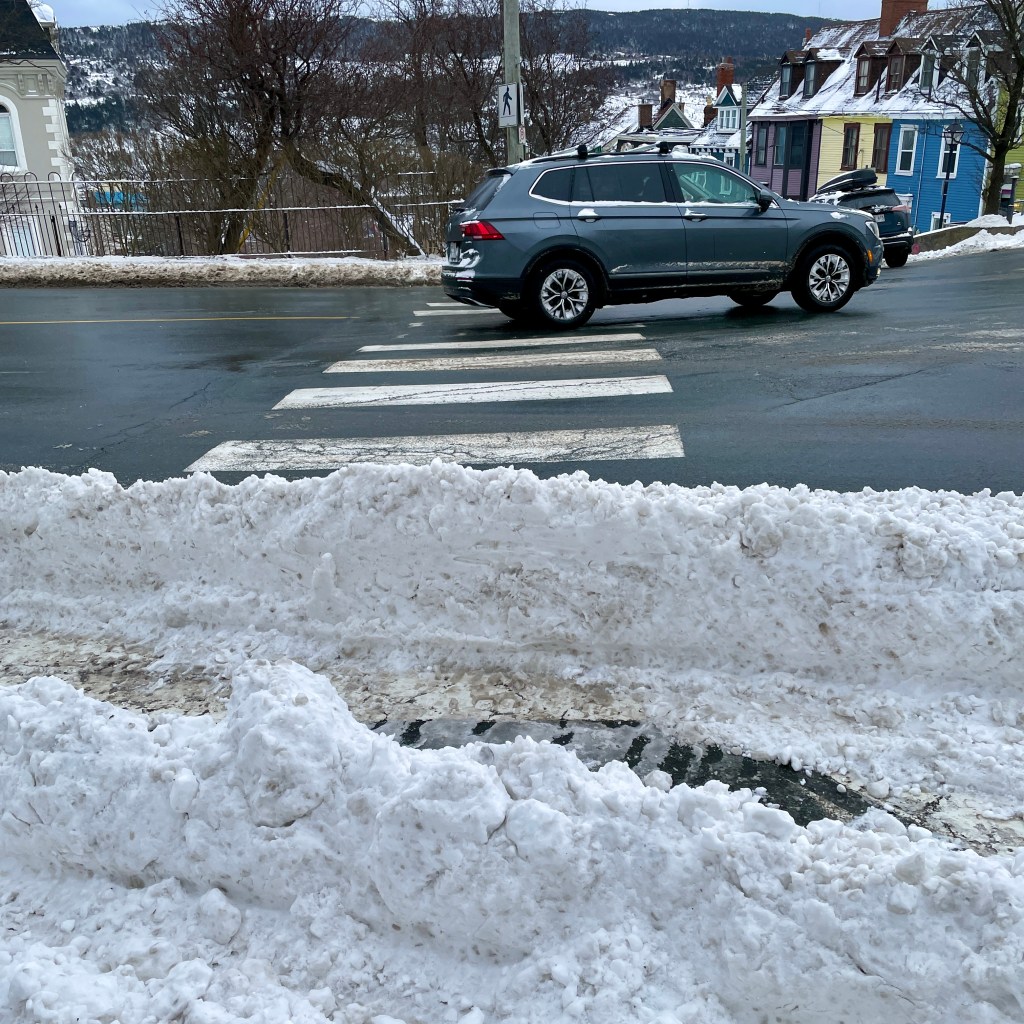
Photo of blocked sidewalk and crosswalk outside old BIS building on Queen’s Rd.

I sent this letter (slightly edited here and with photos and links added) to Councillors Maggie Burton and Sandy Hickman (Lead for Transportation) this morning in response to a letter from another concerned resident that I was copied on. I’ll post responses to my questions when I receive them:

Yesterday I walked along Queen’s Rd, Military Rd. and Bonaventure Ave. and later took the bus for an errand on Kenmount Rd. They were doing the sidewalk on Queen’s Rd as I went out, just after 1:00. The sidewalks on Military and Bonaventure had probably had one pass from the sidewalk plows but sections had been plowed back in again. Most of Kenmount had also had one pass from the sidewalk plow but the last part of our walk to the bus stop at 297 Kenmount had no sidewalk at all. It was getting dark and it was rush hour so walking in the street was nerve wracking to say the least. There was no space cleared at the bus stop either so we had to continue to stand in traffic until the bus came. All of these are Priority 1 sidewalks and three of them are bus routes.
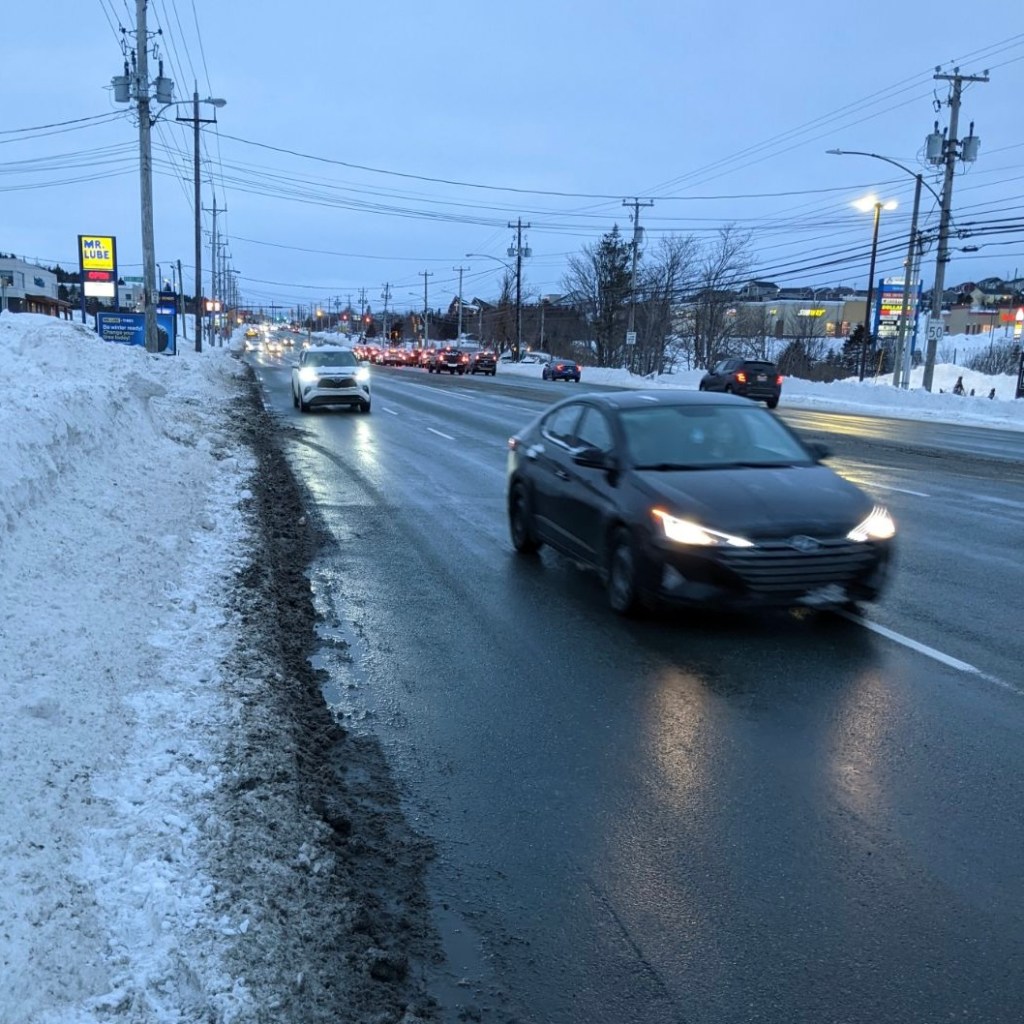
View from the bus stop on Kenmount Rd. with high snowbank and oncoming traffic bearing down on pedestrians

These streets were cleared down to bare pavement during the night and were ready for people to drive to work and school in the morning. People who walk or take the bus (including many with disabilities and many seniors and children) had to commute in the traffic lanes or stay home.

I know there have been significant improvements in the past few years. The problem is that we started at such an abysmal place that the service is still utterly inadequate. After my experiences yesterday I have some questions about the City’s plans for continuing to improve this fundamental part of the urban transportation system:

  1. The sidewalk beside the old BIS building on Queen’s Rd. had a mountain of snow on it because the owners cleared its entrance and left the snow blocking the sidewalk (see the photo at the top of this post). This is just one example among many. As you know, this is illegal but in the past the by-law has not been enforced as an ATIPP revealed. Does the city have any intention to enforce this by-law in future?
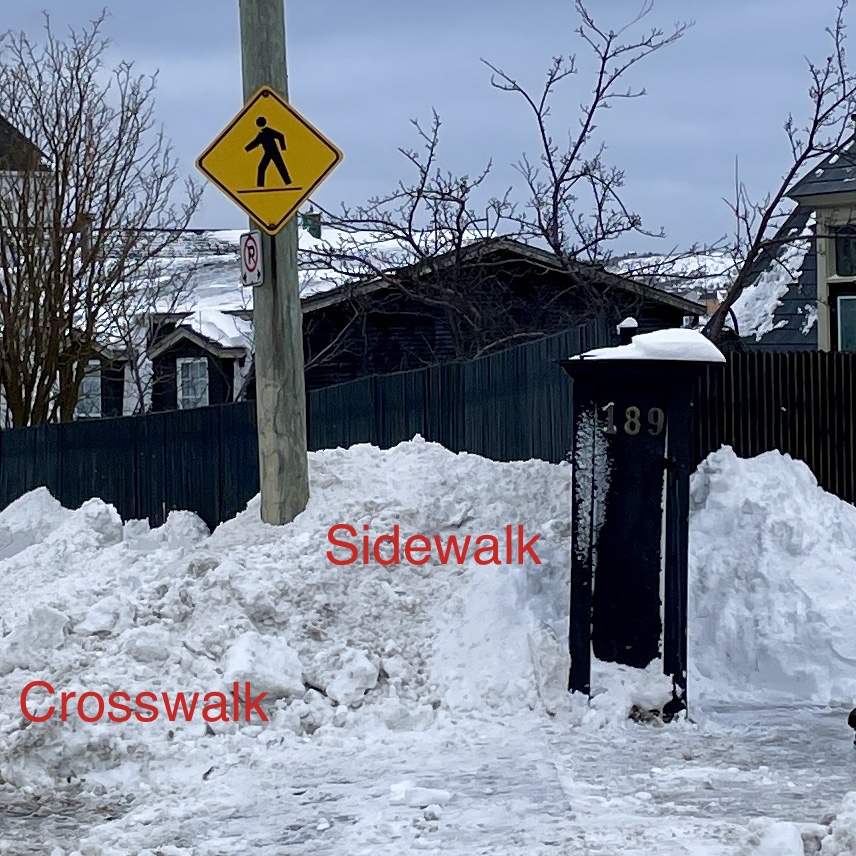
  2. Most crosswalks still had piles of snow blocking access late yesterday afternoon (see photos below). Sandy, during the last election you stated that, in winter, crosswalks, intersections and bus stops “need to be clear with open spaces for access.” There has been some progress on this, which is to say where nothing was done before sometimes they are cleared now, but pedestrians need to be able to rely on safe routes all the time, just as drivers do. Does the City have a plan to make this happen?
  3. The City’s website states in relation to sidewalk snowclearing, “our standards are like other cities with weather conditions comparable to ours.” This is not true. We are an outlier. What our own consultation found in 2014 was that we have higher standards for streets and lower standards for sidewalks compared to other cities. And our sidewalk standards are not just a little lower, they are exponentially lower. Of the five comparison cities in the consultation, four aim to clear all or nearly all their sidewalks within hours—not days—of a snowfall and the fifth has a goal of 62%. In 2021 former councillor Hope Jamieson stated that St. John’s was still clearing only 10% of its sidewalks. How much has been added since then and when will the timelines be shortened?
  4. The province should also have a role to play in this. We are the capital city. Half the population of the province lives in or near St. John’s and the rest come here at times to visit or avail of services. The recent Health Accord showed that this province has the worst health in the country and it is well documented that there are significant correlations between walkability and health. Research done right here by Asia Holloway, Brianne Chafe and Daniel Fuller (which was presented to Council several years ago) showed that investing in walkability would bring four-fold economic returns over ten years. The problem is that the City has to do the investing but the Province would receive most of the returns since they are largely in health care savings. Has the City discussed this issue with the Province?

Thank you,

Elizabeth Yeoman
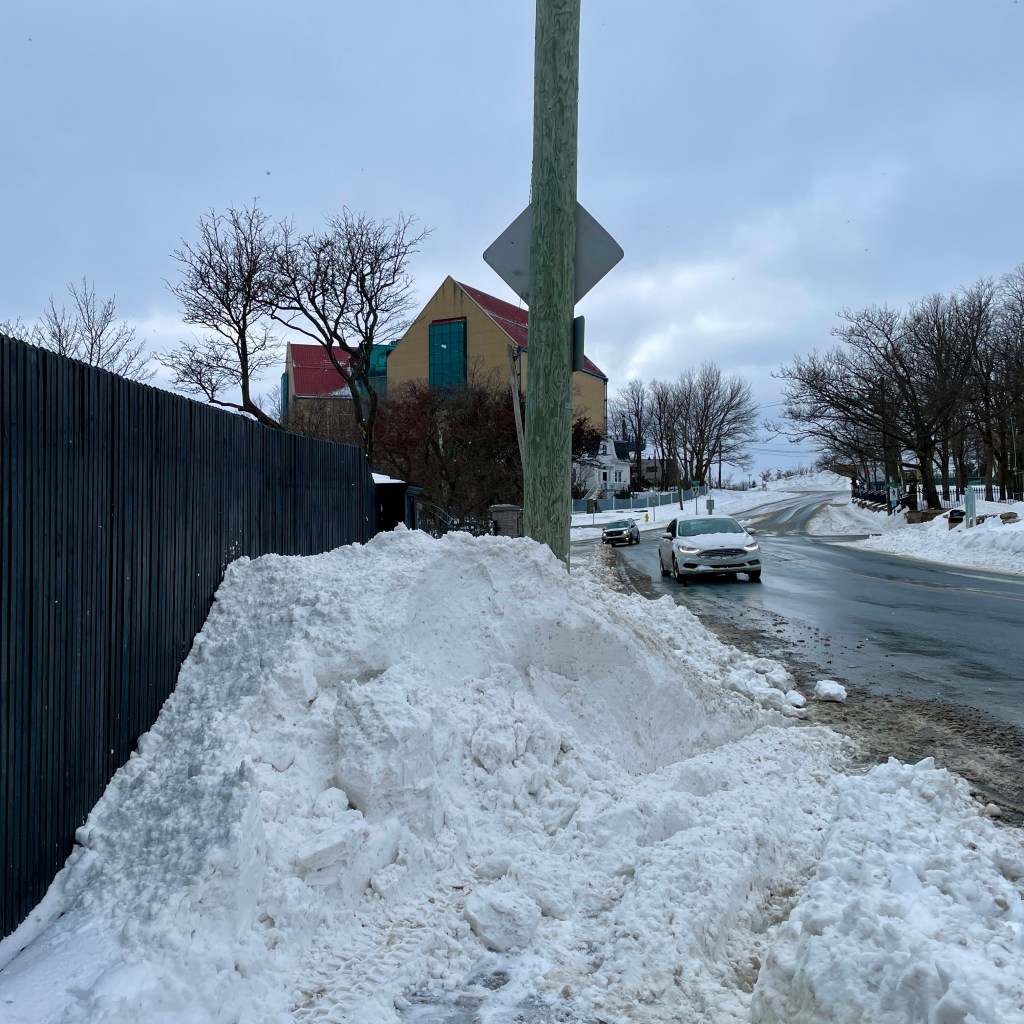
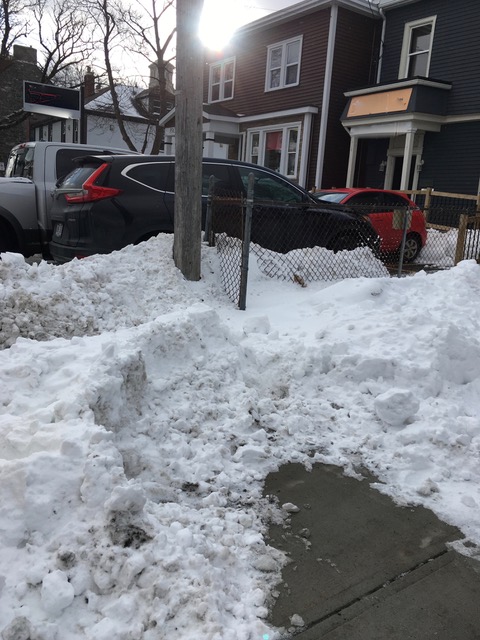
Sidewalk on Military Rd. at Bonaventure completely blocked by a pile of snow left by a city plow.
Crosswalk on Queen’s Rd. blocked by piles of snow left by a city plow
Crosswalk on Military Rd. near the Rooms, the Basilica and two schools, completely blocked by snow on both sides

Sidewalk snowclearing bylaws

One huge challenge to walkability and accessibility in winter is the way property owners and private contractors dump snow cleared from driveways and parking lots onto sidewalks. This was discussed recently at the St. John’s: The Winter Unfriendly City Facebook group. I’m going to summarize the discussion here so it can be found again later.

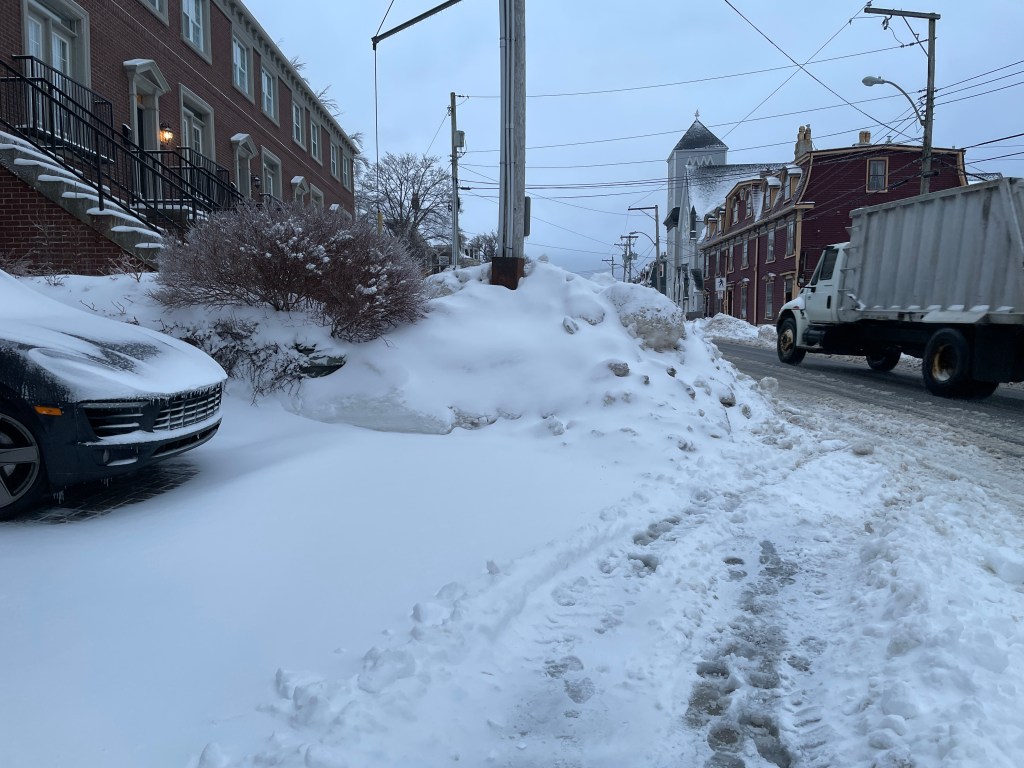
According to Councillor Maggie Burton in this thread, this is permitted as long as the sidewalk isn’t part of the City’s sidewalk snowclearing program. This means it’s permitted on about 90% of sidewalks! However, it’s also very common on sidewalks that are part of the program, as in this photo, showing a huge mound of snow on the sidewalk between 56 Queen’s Rd. and 46-54 Queen’s Rd. where the building owners on both sides have cleared their parking areas onto the sidewalk between them.

Yes, I know. It doesn’t look as though there’s a sidewalk there at all but this is actually a sidewalk that the city is supposed to clear and actually does usually clear within a day or two of a snowfall. But then this happens and pedestrians are forced to walk in the street where that truck is.

People frequently complain to the city about this practice and are told that nothing can be done unless they can prove who did it, as in not the property owner but the actual person who put the snow there. So the onus is on the complainant to either track down the property owner and find out who did their snowclearing (if they can be tracked down and are willing to share that information) or to see the person in action and photograph them or get their license plate if they happen to have a vehicle. It also requires constant monitoring, documenting and complaining to the city on the part of sidewalk users, as well as the unpleasant possibility of confrontation.

So, what are the by-laws that apply here?

At the city’s snowclearing priority page it says, “St. John’s Snow Removal regulations require properties adjacent to designated downtown streets to keep their sidewalks clear of ice and snow.” So “properties,” not “persons.” But the actual by-law (1098) does use the word “person” in some places and “abutter” in others. An “abutter” is defined as a lessee, owner or occupant of a property and, on some specific downtown streets, abutters are required to clear snow from sidewalks in front of their properties. But in the case of people depositing snow on sidewalks, the word used is “person.” The same by-law states, “No person shall deposit snow or ice upon any street or sidewalk which street or sidewalk is cleared of snow or ice by the City” and “No person engaged in removing snow or ice from any property or other premises shall do so in any manner that obstructs vehicular traffic on a street or pedestrian traffic on a sidewalk.” So “abutters” are responsible for removing snow in certain areas but “persons” are responsible for not blocking sidewalks. Can this wording be changed? Councillor Burton said on the Facebook thread that she would look into it so I’ll update later when we have an answer.

The bigger question is why these by-laws aren’t enforced, considering that these piles of snow force people to risk life and limb by walking out into busy streets. An ATIPP in 2020 revealed that between 2016 and 2020 not a single fine was levied to enforce by-law sections 7 and 8 against blocking sidewalks. Still, changing the wording of the by-law would at least mean the city would have to think about the law, and would no longer be able to use this particular excuse for doing nothing.

Isn’t there a double standard here?

IMG_3491

We’re doing better at making the city safe for pedestrians. We really are. This sidewalk was plowed by the city within hours of the end of the snow storm on Monday. Then all this snow was dumped back on it to create private parking. Isn’t this against the law? I hid the names of these businesses because I’m not trying to target them specifically. Hundreds of businesses and homeowners do this. If it’s illegal to have a basketball net on a sidewalk in a cul-de-sac in summer, how can it not be illegal to do this in winter?

The law cited in the basketball net story was Section 149.1 of the St. John’s Act , which states:

“Penalty for obstruction
149. (1) A person shall not, within the city limits place or deposit on a street or sidewalk, except in transit, boxes, barrels, packages, or other matter or thing, so as to obstruct free passage on the street or sidewalk.”

Meanwhile, Matt Milner from the St. John’s Winter-Unfriendly City Facebook Group pointed out that there are also laws specifically about not putting snow on plowed sidewalks so the answer to my question above is yes, it is illegal. Even though it’s a different law, it’s still a striking contrast to the response to a very minor sidewalk obstruction in summer. Does anybody know how often this law is enforced? Here’s the relevant section from the St. John’s Snow Removal Regulations:

7. (1) No person shall deposit snow or ice upon any street or sidewalk which street or sidewalk is cleared of snow or ice by the City.

(2) Any cost to the City of removing snow or ice deposited in violation of subsection (1) shall, in addition to any penalty prescribed hereunder, be recoverable from the violator or abutter.

8. (1) No person engaged in removing snow or ice from any property or other premises shall do so in any manner that obstructs vehicular traffic on a street or pedestrian traffic on a sidewalk.

(2) Any cost to the City of removing snow or ice deposited in violation of subsection (1) shall, in addition to any penalty prescribed hereunder, be recoverable from the violator or abutter.