A Radical Suggestion

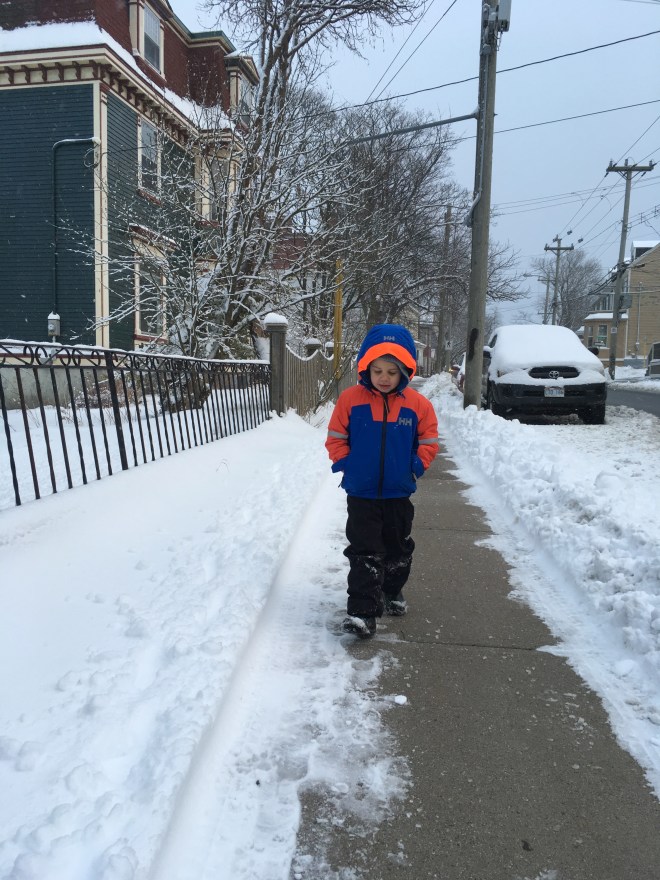
jeffrey-blum-399705-unsplash

Photo by Jeffrey Blum on Unsplash

What if we banned or strictly limited cars in city limits? I know this seems like a very radical suggestion here in St. John’s but many cities have done it, for example Zurich, where 32% of people get to work by transit and 42% on foot or bike and Copenhagen, where people protested, “We’ll go broke, and the weather’s too bad for people to be outdoors” but ended up loving their car free city. Our weather is worse and we’re probably broker but wouldn’t we actually save money if we only had to plow the sidewalks and bike trails, and a single lane in each direction on bus routes? We could use that money to get more buses and build more bike and walking trails.

What else might we gain if we did this? We’d be safer, for one thing. Canadian road fatalities fell 15.2% between 2010 and 2016 but pedestrian deaths increased by 10.5% in that same period (source). Newfoundland and Labrador have the fourth highest rate of pedestrian fatalities (7.9 per 100,000 population) and the second highest rate of pedestrian injuries (624.4 per 100,000 population) (source). Removing cars would drastically lower these figures. We’d also be healthier. It’s well known that regular walking lowers the risk of heart attack and stroke as well as having many other health benefits. Walking, cycling and public transit use can all be key to preventing premature deaths and diabetes. There are also links between getting around without a car and mental health and happiness. Interestingly, this includes not only active transit but also public transit use. So, while it might take longer for emergency services to reach us if only main bus routes were plowed, most of the province already has to wait longer for those services and, on the up side, we’d have much less need of them.

I’ll continue to explore this topic in future posts but would love to hear from you in the meantime. What do you think?


Are we getting better?

I’ve been meaning to post a link to the video Sharon Roseman and I made about sidewalk snow clearing. Most of the filming was done in 2014, just before the KPMG Review of Winter Maintenance Services in St. John’s, so the film turned out to be kind of a benchmark for what things were like before the city started implementing the recommendations of the review. It also documents the activism that led to the review. Here it is:

Honk If You Want Me Off the Road from Elizabeth Yeoman on Vimeo.

And here are a few of the review recommendations, mainly the ones relating to pedestrian needs, and my brief comments (in blue) on how they’ve been implemented since the review:

-Sidewalk service levels should be improved by starting earlier and focusing on high priority sidewalks.

(Much of the recent $150,000 increase in the snowclearing budget was to allow for an earlier start to sidewalk clearing. Snow removal crews are also working seven days a week instead of five. My own experience is that this is happening after lighter snowfalls but not so much after heavier ones, when drivers of motor vehicles are still given priority over pedestrians. We need much more discussion of what the word “priority” means.)

-Snow removal should start earlier during snowfalls to improve sidewalk and road conditions, using privately hired equipment (trucks and loaders) to expand capacity during major events.

(This year an additional 11 km of sidewalk snow clearing is being done by sub-contractors, which is intended to help city staff get the rest cleared sooner.)

-Seasonal workers should be engaged for a longer season (18 or 19 weeks, instead of 16 weeks) to provide resources for early or late storms; the city should also allow more time for training early in the season.

(If this has been done, I haven’t seen it published anywhere.)

-The training program should be expanded, focusing on improving effectiveness, reducing equipment damage and improving supervisory skills with three new seasonal trainer positions.

(I haven’t seen any information published on this either. What I have seen is a lot of “duelling plows,” as Sonja Boon calls them, where the street plow drivers plow the sidewalks back in after the sidewalk plow drivers have been through. Surely this could be avoided with better training.)

-A revised protocol for handling 311 calls on snow issues should be developed and external communications improved.

There’s a new app that allows people to report in detail on snow issues. You can also still call or email them. Anecdotally, I’ve heard that response is good and that has been my experience. But should we really have to be contacting the city as often as we do just to be able to get around safely?

-Plan for a new snow dumping site besides in St. John’s harbour, to minimize traffic congestion and for environmental reasons.

This has not been done as has recently been highlighted in the media.

I only know what I’ve read in the media or experienced myself so it would be great to hear from others. Do you have information I am missing? And what have your experiences been like as you move around the city?

Meanwhile in other cities: Sonja Boon reporting from Halifax

And I Walked
Sonja Boon

Winters in St. John’s are hard. It’s a truism that almost doesn’t need to be spoken. After all, the weather sucks. The shoveling—especially the end of driveway—seems to go on and on. And honestly, who wants to be shoveling in May when the rest of the country is cavorting in the sun, and has been for months?

But that’s not the main reason why I find St. John’s winters hard.

There are extreme winters in other parts of Canada (hello, Winnipeg). There’s lots of shoveling in other parts of the country (hello, Ontario). And honestly, while other parts of Canada are cavorting in late April, we get them back in November when they’re buried under a foot of snow and we’re cavorting.

Winters in St. John’s are hard on my mental health.

And they’re hard on my mental health because I spend too many months feeling trapped. I can’t get out in winter. I can’t move properly. I can’t walk to the store. Or to the library. Or even to work. Because I can’t count on there being a sidewalk, let alone a safe sidewalk, to use. When I go out, I hunch myself in, holding myself tight. I don’t breathe freely. All of my energy goes to making sure that my body is safe, that I don’t accidentally end up on the road, or with a broken leg, or….

Winter in St. John’s is bad for my mental health and it has nothing at all to do with the weather. Or the shoveling. Or our late spring. Rather, it has everything to do with the city’s lack of interest in pedestrians.

And I’m an able-bodied person. What must winter be like for people with disabilities. Or mobility issues. Or with strollers?

This week, I’ve been in Halifax for research. I’d never visited Halifax in winter before, so I didn’t know what to expect. What I found were wide, salted sidewalks. Everywhere. Even the HarbourWalk was salted.
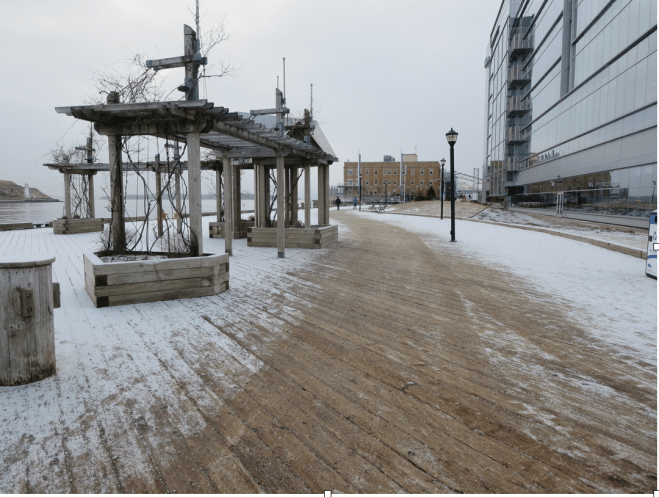
screen shot 2019-01-21 at 18.02.01Halifax HarbourWalk at 9 am. Just a hint of snow overnight and they’d already salted the whole boardwalk. There were joggers out. And people walking dogs. And others, like me, just feeling the air.

And so I walked. And I walked. And then I walked some more. On the first day, I walked for over two hours straight. Just because I could. It was gorgeous weather: sunny and just below zero.

It was -8 the second day, close to -20 with the wind chill. But still I walked. And I walked. And I walked some more. Another two hours. Just because I could.
screen shot 2019-01-21 at 18.04.23
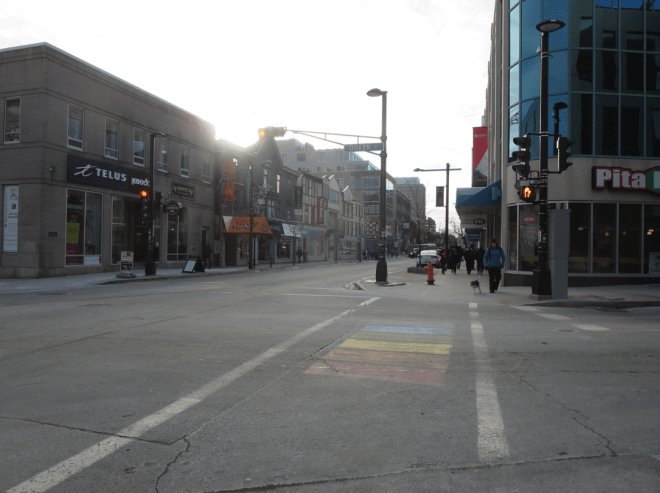
Look at the lovely sidewalks on Spring Garden Road! Loads of pedestrians, too, although I tried not to take photos of them.

I walked to feel the air. I walked to breathe. I walked to feel my body moving. I walked for the sheer pleasure of moving my body freely in the winter. I walked because I didn’t have to hunch myself over, picking through the ice and snow. I walked because I could hold my head high, because I could turn my attention away from fear and toward feeling the air against my skin, my feet moving confidently, one in front of the other. I walked because I could. Because I didn’t have to worry that I would end up upside down somewhere.
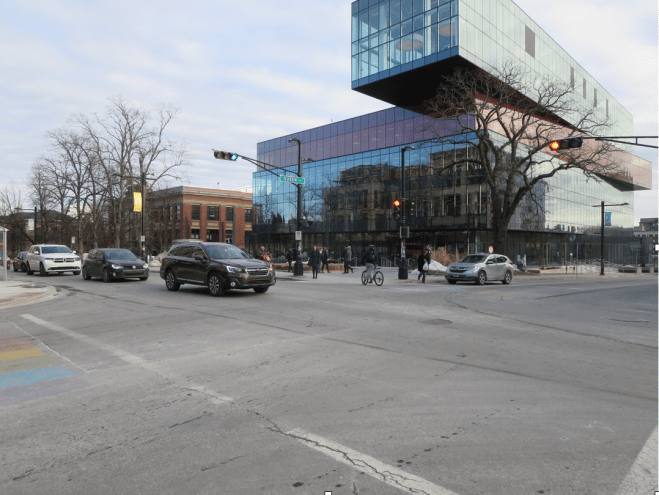
screen shot 2019-01-21 at 18.06.38
Look at the beautifully cleared and ice-free open space in front of the library – safe for wheelchairs and strollers and anyone who wants to go the library.

I realized, sometime during that second day, that I hadn’t felt this free in winter in years. Eleven years, to be exact, since our first winter in St. John’s.

It was ….
Wonderful. Exhilarating. Liberating.
It was incredible.

But it couldn’t be normal, right?

It must have been an easy winter.
It must be better weather in Halifax.
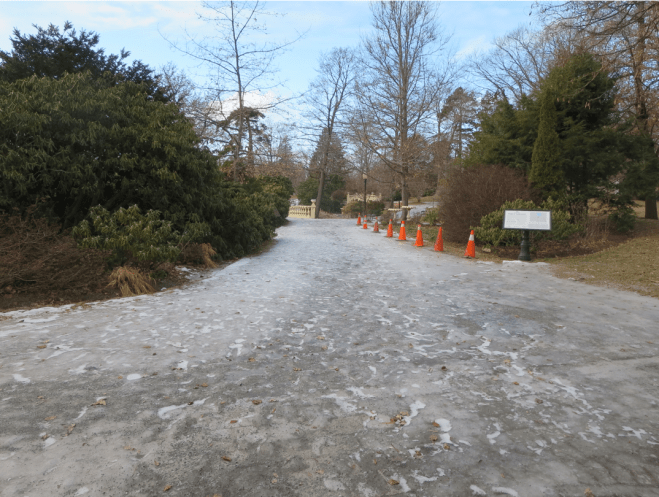
screen shot 2019-01-21 at 18.07.54
Where you can’t walk in Halifax: The Public Gardens are a skating rink right now, and their existence shows what happens when a city doesn’t keep up with the regular salting and clearing. They’re also closed to the public right now, which is probably wise.

What was Halifax’s secret?

I asked a friend, a Haligonian from birth who has spent the last four years living in St. John’s. Two weeks ago, she returned to Halifax to work on her thesis proposal over the winter term. I figured that if anyone would know the scoop, she would.

“So, what’s the deal? Is it always like this, every winter? Or is this just a weird winter?”

“It’s always like this,” she said. “And after four years in St. John’s, I’d totally forgotten. It’s amazing.”

She told me that she’d been raving about it to friends, other Haligonians she’s known for decades.

“I keep commenting on it and they just don’t get it, because it’s normal….”

Let’s just pause right there.

Because. It’s. Normal.

Nothing else. There is no magic.

Just…because it’s normal.

And so it should be in St. John’s.
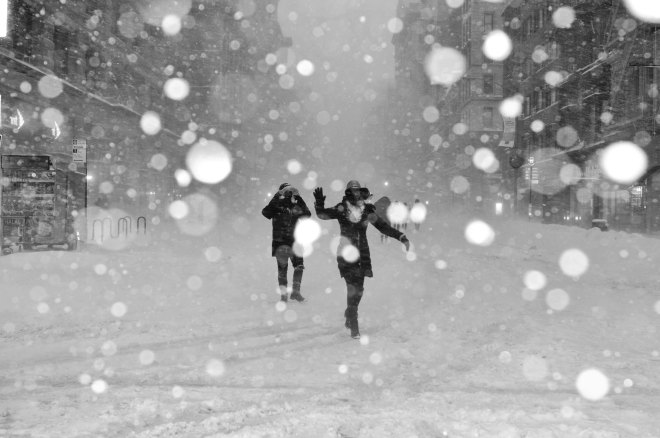
Meanwhile In Other Cities 2

I’m planning to have a series under this title. This one will just be a short post to note this excellent article hot off the online press with an overview of issues and approaches in several US cities, “Why Cities, Not Individuals, Should Clear Snow From Sidewalks,” by Kathi Valeii from CityLab (Jan. 11, 2019). With thanks to David Brake of the Essential Transit Association.

Meanwhile In Other Cities…

img_3401

The 2014 consultation on snow clearing in St. John’s used several other cities for comparison: Mount Pearl, Fredericton, Halifax, Québec City and Saguenay. It’s hard to find a good comparison for St. John’s because it really is unique. But the authors believed that these cities together represented most of the challenges St. John’s faces: hills, buildings directly on the street, old infrastructure, heavy snowfall. A key finding was that St. John’s actually had a higher standard of street clearing than other cities but a lower standard of sidewalk clearing. In other words, drivers were more of a priority here than in other cities and pedestrians less of a priority. I’m not sure if that’s still true or not because there have been major improvements in St. John’s sidewalk clearing since the consultation and the election of a new mayor and council who are much more supportive of active transit and accessibility. What I am sure of is that we still have a long way to go here in St. John’s before we can say that pedestrians are a priority.

In an earlier post, I compared St. John’s to Moncton — very different cities but two things they have in common are a somewhat similar size and a similar amount of snowfall. On average, St. John’s receives 335 cm of snow each year  and Moncton 311. Moncton cut its sidewalk clearing budget in 2015. But what’s interesting is to compare the attitudes in Moncton and here. The cuts in Moncton led to only one side of some residential streets being cleared instead of both sides and this was considered to put children at risk when walking to school because they would have to cross the street. Here, most residential streets still have no sidewalks at all and even major streets may have only one side cleared, or none. Last year, Moncton bought two new sidewalk plows to help bring service back to former levels. City Councillor Bryan Butler said in support of improved sidewalk clearing, “‘When you turn on your tap, you expect water. When you put your garbage out, you expect it to be picked up. When you go to walk on your sidewalk, you expect it to be plowed and your streets plowed, you know.”

Would anybody in St. John’s say “When you walk on your sidewalk, you expect it to be plowed?”


Infrastructure

I got a lot of response to a tweeted link to a video about a program in Bologna, Italy that rewards people for using active transit.

My fellow campaigner for accessibility and active transit, Sonja Boon, sent a thought-provoking response: She says she is “not a fan of ‘good behaviour’ rewards because what constitutes good behaviour? And what if you can’t access any ‘good behaviour’? Build a good system, shift focus away from cars, and people will come. The Dutch, for example, got their enviable network of cycle paths because of deliberate political decisions. The infrastructure was central. St. John’s has a series of fantastic walking trails because of similar deliberate decisions. It could make similar choices today.”

I agree, absolutely. Infrastructure and political decision making are central. Funnily enough, the article in which I read about the rewards program also made this exact point. The author, Sandy James, says that Britain’s National Institute for Health and Care Excellence (NICE) has drafted guidelines that prioritize pedestrians, cyclists and transit over cars. Britain’s Department for Transport says in response to NICE that its own guidelines are also “crystal clear that street design should explicitly consider pedestrians and cyclists first”. James contrasts these policies with Vancouver, where there is no pedestrian plan. That made me wonder what we have here in St. John’s so I looked it up.

St. John’s Transportation plan actually has quite a lot about pedestrians, for example: “…creating walkable streets … and ensuring that neighbourhoods are connected to these areas by the network of local streets, sidewalks, pathways and trails.” It also talks about increasing mobility options, community building and place making. And they’re working on a new cycling plan. It even has a very sweet ad.

I didn’t find a lot of details on the Transportation Plan though so I’ll look into it and write another post later. Publicly espousing these values is already a good start. Anything that gets positive attention for accessibility and active transit can contribute to building a culture that sees pedestrians as having the same rights of access as vehicles (or perhaps even greater rights, as proposed in Britain — after all, they are helping to lower health care costs and reduce pollution, traffic congestion and parking problems). That might include rewards and cute ads. But, far more importantly, it includes the decisions and the infrastructure that make it all possible.


A little good news

IMG_3338The morning after the snowfall on the week-end the sidewalks in my neighbourhood were cleared! Not only that but I heard from a couple of people in other neighbourhoods that theirs were too. Councillor Ian Froude explained last fall that one of the priorities for the additional $150,000 for snow clearing in the new budget was making sidewalk clearing more efficient and it looks as though it’s happening. We still have a lot of work ahead to make our city truly accessible to everyone year round but this really is good news. Happy new year!


What are our priorities?

DSC_0242

A fascinating article by Brent Toderian in the design magazine Fast Company discusses five steps to making better cities. Step 4 is “doing the right things badly.” I’d say that’s where we are now with sidewalk snow clearing in St. John’s. We are doing it, at least more than we used to, but it’s really hard to stay positive when it’s done so slowly and so badly. It’s even more frustrating when you see money spent on other things that make far less (if any) difference in the quality of life in the city.

The sign in the photo above was posted on our street the night before last. No problem at all to drive or park on the street but a crew was sent out to remove the last few scraps of snow. Meanwhile, so many people are prisoners in their own homes because they don’t have access to sidewalks and are (rightly) afraid to walk in traffic. Even worse to know that those people are often seniors, parents on their own with young children or people living with disabilities and that they can’t get out even to get groceries or basic health care, let alone to see their friends and enjoy this beautiful city.

Yes, the city really is doing a better job than it did at clearing sidewalks but it’s still doing far too few and very poorly. That same day I walked along Empire Avenue — a very busy street with a lot of pedestrians — and there were still no sidewalks, ten days after the last snowstorm.

IMG_3263.jpeg

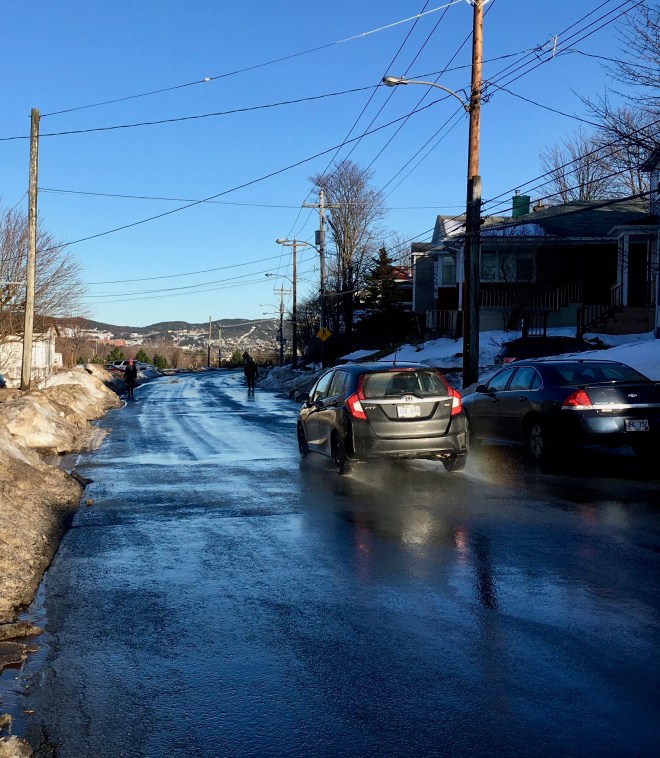
I also walked around a large block (Bonaventure, Merrymeeting, Newtown and Mayor). The sidewalks there had all been cleared but they still weren’t usable by anybody with a stroller or a mobility aid.

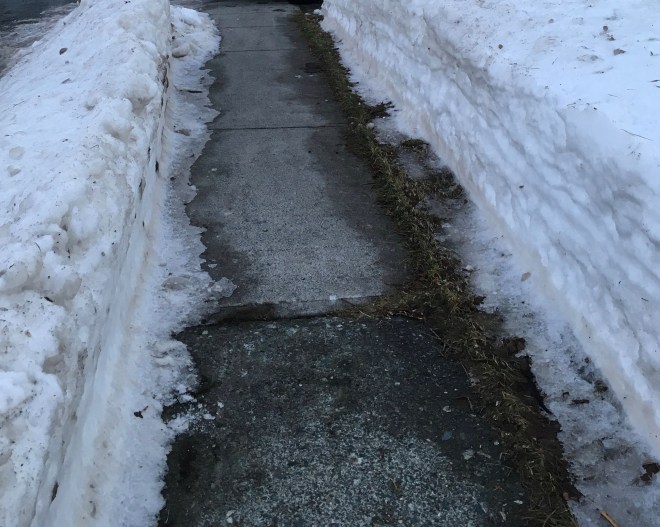
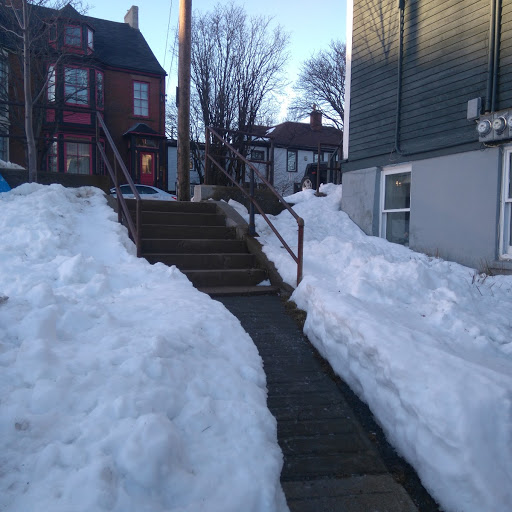
The sections that are still blocked in were left that way because the sidewalk plow couldn’t get past the telephone poles. But, for the huge benefit this would be for so many people, couldn’t a crew do those sections with shovels? They did a staircase at the top of my street that way, but that staircase leading to a tiny one way residential street is much less important than pedestrian access on major streets like the ones in these photos. To end this post with a view of what can be (and is!) done by a couple of people with shovels, here’s the staircase:

DSC_0240


Perambulator

Epic2

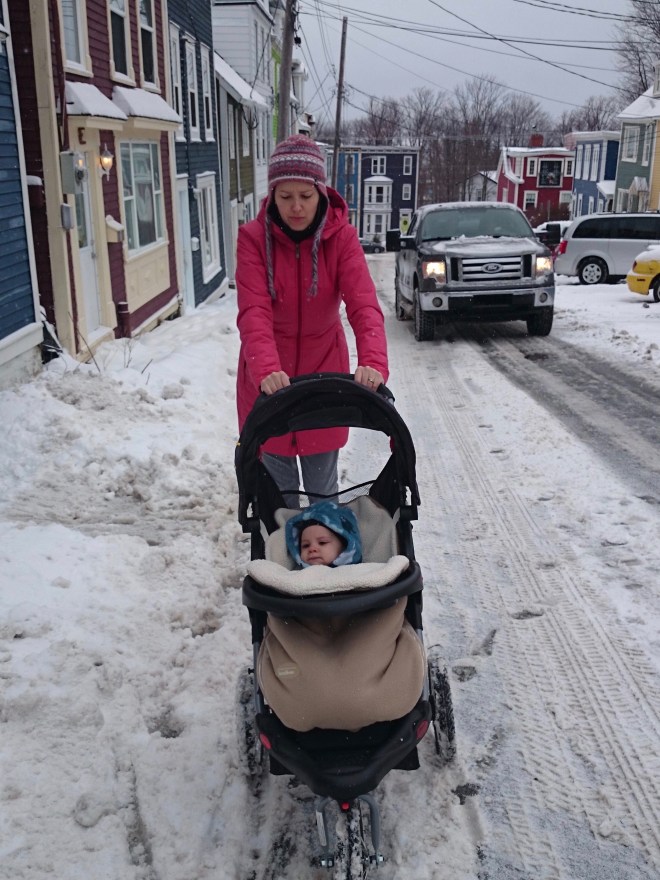
Perambulator is a performance art project by British walking artist, Clare Qualmann. The project explores peoples’ experiences getting around with strollers, or prams as they’re called in England. According to her artist’s statement, “the project invited other pram users (predominantly mothers) to walk together exploring and highlighting the everyday awkwardness of pram use in the city.” As they walked, they encountered obstacles such as curbs that were too high, cars parked on the sidewalk, and barriers intended to keep mopeds and dirt bikes off walking trails but also making it very difficult for people with strollers. Here in St. John’s in winter, multiply this “everyday awkwardness” exponentially. The photo above is my daughter-in-law with my grandson. She agreed to pose with him but in reality they rarely dare to go out walking in winter because it’s so dangerous.

Not long after I moved to St. John’s, 28 years ago, I went to see satirical singer-songwriter, Nancy White, in concert at the Arts and Culture Centre. I still remember vividly my reaction to her song “Stroller Ladies” about pushing a stroller around Toronto, where residents are legally required to shovel their own sidewalks but some don’t. She fantasizes about what she would do if she were the judge doling out penalties for not shovelling: she would condemn offenders to be “sent to live in Moncton where you’ll soon regret your crime, you’ll be caring for twin babies… there’ll be no sidewalks shovelled…” Well, I actually did have twin babies in Moncton and I wanted to stand up and yell, “In Moncton, the City clears the sidewalks!!”

Writing the above made me start wondering whether I was remembering Moncton through rose coloured glasses so I looked online and found a map showing the sidewalks they clear, colour coded for levels of priority. Have a look. In downtown Moncton, they clear every single sidewalk except for a few dead ends on the outer edges.

Screen Shot 2018-12-15 at 10.38.55

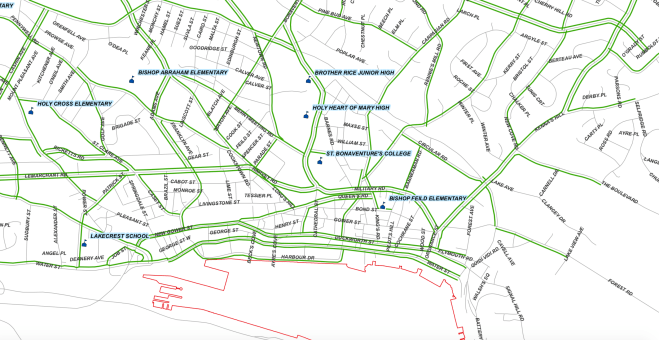
Compare that with the map showing downtown St. John’s sidewalks to be cleared. (I won’t even go into whether they actually are cleared. I’ll save that for another post.)

Screen Shot 2018-12-16 at 00.10.23